Garmin Forerunner 970 vs Fenix 9 | Which Is Better In 2026?
| Comparision | Product | Rating | Price |
|---|---|---|---|
 | 9.3 | Check Lowest PriceRead Review | |
 | 9.2 | Check Lowest PriceRead Review |
Our Verdict
The Garmin Forerunner 970 and Garmin Fenix 9 are top-of-the-line premium GPS watches. Both watches include many of the same activity profiles and exercise metric tracking. However, the price difference is stark: the Fenix 9 costs anywhere from $250 to $550 more than the Forerunner 970, depending on the model you choose.
Based on our real-world testing, both the Fenix 9 and Forerunner 970 scored the same in navigation, GPS, running metrics, and heart-rate accuracy testing. One may now wonder why there’s such a big price difference.
The Fenix 9 has exclusive features such as Garmin InReach for emergency SOS signaling, plus more storage, longer battery life, more detail on its topographic maps, and one new running feature: stamina zones.
Overall, the Forerunner and Fenix 9 are similar. However, some may want to upgrade to the Fenix 9 for its exclusive features if you plan to use them.
See our individual reviews of each: Garmin Fenix 9 review and Garmin Forerunner 970 review.
GPS and Heart-Rate Acurracy: 25%
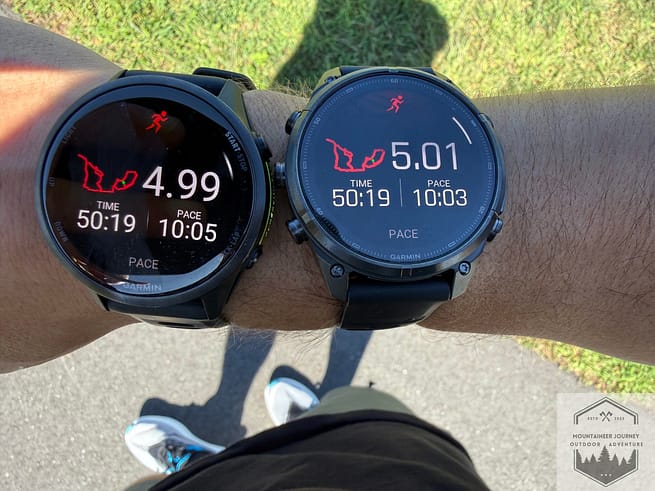
The Garmin Forerunner 970 and Fenix 9 use the same Elevate V5 sensor for heart rate and other measurements.
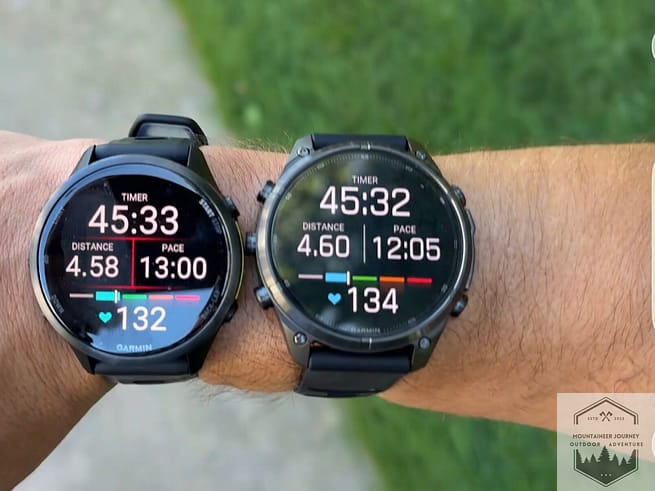
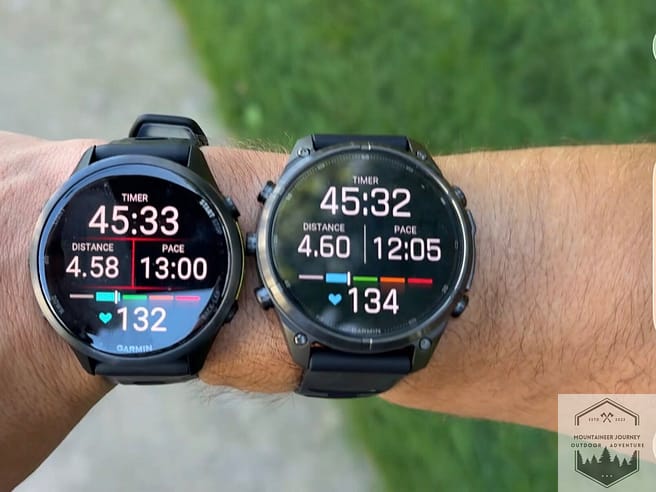
I tested both watches side by side during trail runs, hiking, running, walking, and all-day wear. I also tested them using the Polar H10 strap for heart rate monitoring.
I developed a coding system to compare GPS accuracy and heart rate data from the Fenix 9 and Forerunner 970 during the same run, using the Polar H10 chest strap.
Heart Rate data: Fenix 9 vs Polar H10

Heart rate data: Forerunner 970 vs Polar H10

| Forerunner 970 Metrics | Value | Fenix 9 Metrics | Value |
|---|---|---|---|
| Cadence Lock Duration | LOCKED – 268s | Cadence Lock Duration | LOCKED – 93s |
| Fréchet Drift | 21.0 ft | Fréchet Drift | 15.3 ft |
| Cross-Track Error | N/A | Cross-Track Error | 2.0 ft |
| Distance Over-Report | -1.1% | Distance Over-Report | -0.1% |
| Multi-Watch Drift | 19.2 ft | Multi-Watch Drift | 20.9 ft |
| Mean Absolute Error | 2.3 bpm | Mean Absolute Error | 0.9 bpm |
| Root Mean Square Error | 4.4 bpm | Root Mean Square Error | 2.2 bpm |
| Maximum Delta | +33.9 bpm | Maximum Delta | -27.1 bpm |
| Bland-Altman Bias | +1.2 bpm | Bland-Altman Bias | -0.2 bpm |
| Lin’s Concordance | 0.968 | Lin’s Concordance | 0.992 |
| Interval Latency | 16.0 s | Interval Latency | 13.0 s |
Looking at our table from a 5-mile interval run for both watches, compared to the Polar H10 chest strap, you can see the Fenix 9 was just under 1 bpm variance, while the Forerunner 970 was closer to 2 bpm. This isn’t a major difference, as the one- to two-beat-per-minute variance from the Polar H10 chest strap shows that both Gen 5 heart rate sensors are extremely accurate.
Another interesting data point is interval latency: 13 seconds for the Fenix 9, while the Forerunner 970 had 16 seconds. This isn’t a huge deal, as most wrist-based sensors take a little more lag time than chest straps to match updated interval zones.
This isn’t a huge difference if you do 8-mile interval runs; however, 30-second hill intervals could take almost the entire time before you catch up to pace and start slowing down.
Both watches provided GPS accuracy within 21 ft of our pre-routed GPX maps. This level of accuracy is exceptional for wrist-based GPS devices. You can’t expect better from either watch, and both excel in GPS performance.
Overall, the 970 and Phoenix 9 are at the top of their game for GPS and heart rate accuracy. Overall, both passed our objective testing with flying colors.
Garmin Fenix 9 GPS & Heart Rate Accuracy: 5 out of 5
Garmin Forerunner 970 GPS & Heart Rate Accuracy: 5 out of 5
Winner: Tie
Maps & Navigation: 20%
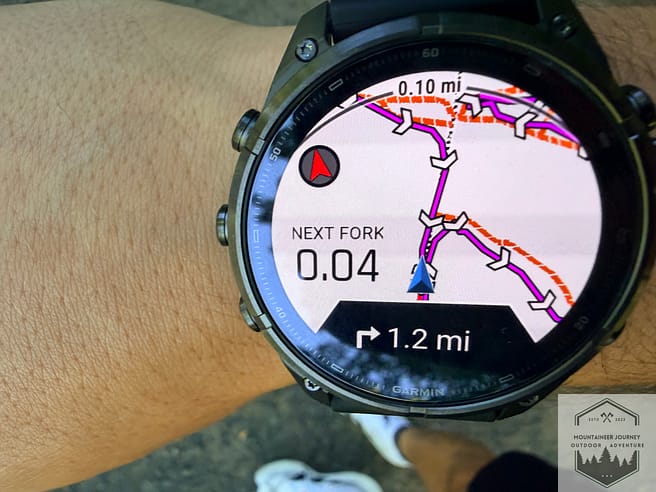
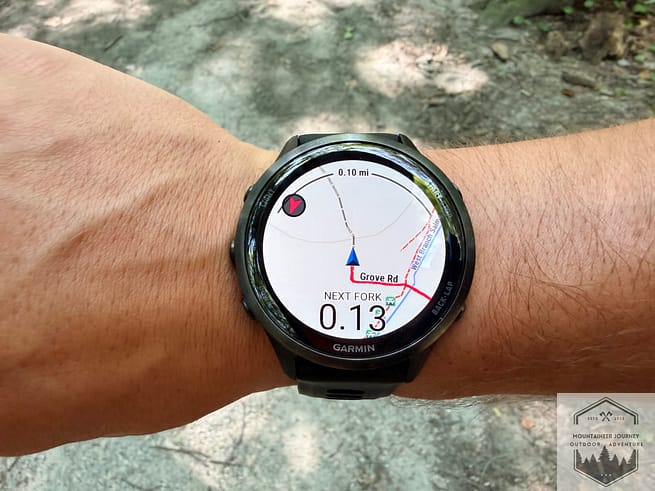
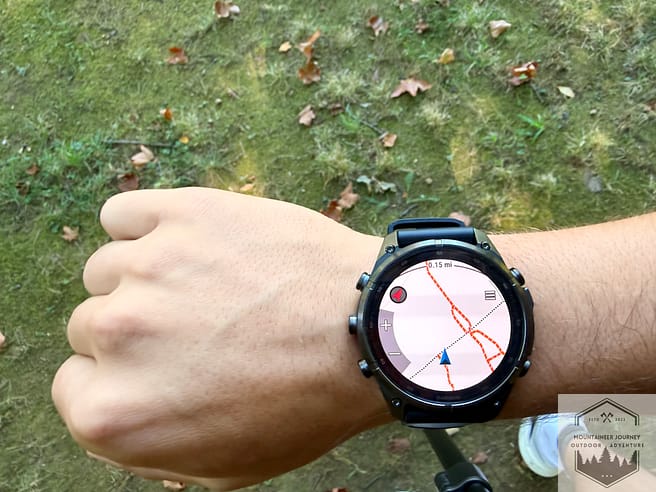
Both GPS watches offer turn-by-turn navigation, tracback, back to start, full topographic maps and ClimbPro. I tested both watches extensively through multiple trail runs, hikes, and runs. I used both in dense forest cover and purposely off-route to trigger alerts.
On the Fenix 9, navigation via topographic maps was much improved compared to the Fenix 8. Panning and zooming were much better, but still clunky at times because of loading speeds. I followed multiple preloaded maps, used turn-by-turn navigation, and easily read the next fork-turn points. The Navigation was spot-on with the Fenix 9.
One feature exclusive to the Fenix 9 (not the Forerunner 970) is perspective view. This gives you a top-down 3D view of upcoming terrain with better contour lines, giving you a much better sense of what’s coming next. This was helpful on longer hikes with tighter trails and variable elevation changes.
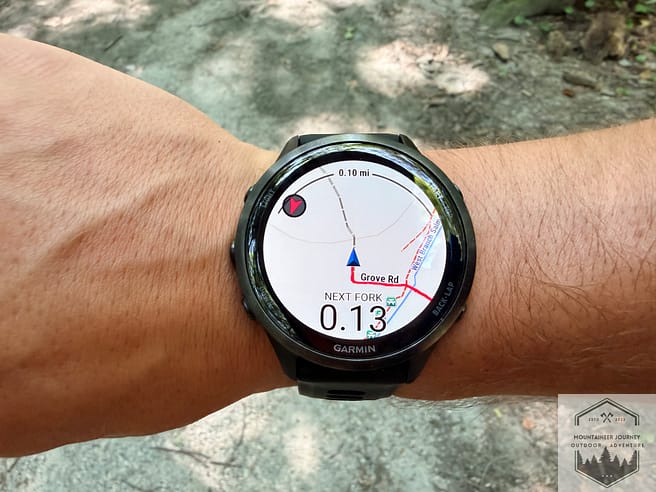
I tested the Forerunner 970, the exact same as the Fenix 9, on multiple outings and with pre-loaded maps. The experience was nearly the same; however, I noticed the 970’s brighter screen made it much easier to read the maps, rather than panning and zooming on the Fenix screen, because I couldn’t see as well.
The off-trail alerts were slightly quicker on the Forerunner 970; however, it was negligible compared to the Fenix 9. Overall, both watches are made for real multi-day adventures with dependable navigation and pre-loaded maps for daily runs.
The perspective view on the Fenix sign shouldn’t make or break the decision between these watches. While it is useful, it’s not a deal breaker for most people.
Fenix 9 Maps & Navigation Score: 4.5 out of 5
Forerunner 970 Maps & Navigation Score: 4.5 out of 5
Winner: Tie
Activity Tracking & Training: 15%
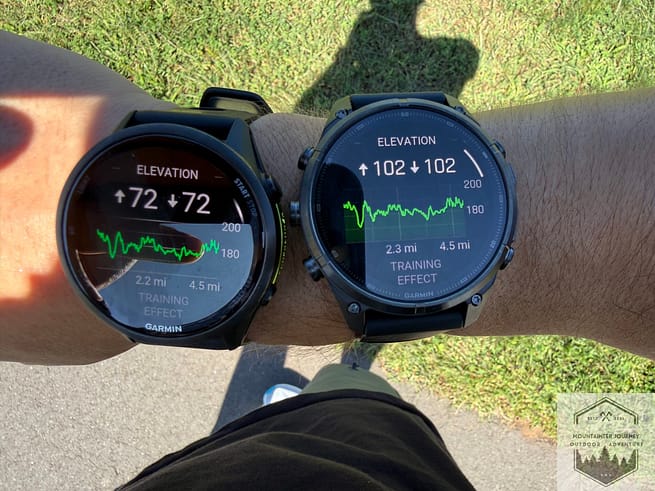
Both Garmin watches offer robust activity tracking and multiple multisport features. The running metrics are extensive, including multiple running economy features, training effects, training load, and suggested workouts.
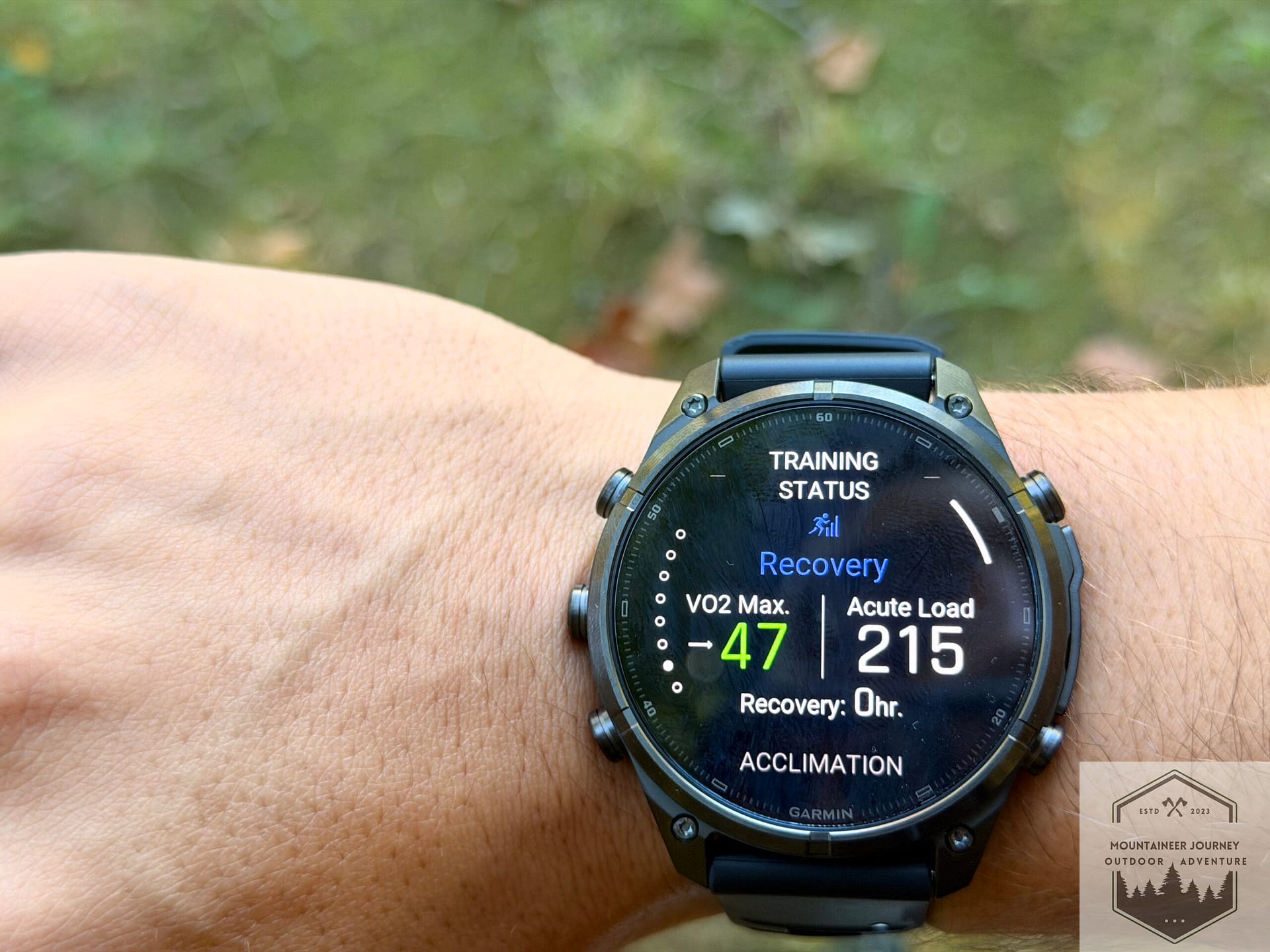
The features I found most helpful were the training readiness feature, which helped me calculate my VO2 max quite accurately on both watches. Also, in terms of running accuracy, both watches will correlate a heat acclimation score and not knock down your VO2 max for having a slower pace in extreme summer heat, this is only available for premium watches, lower end models do not have heat acclimation such as the Forerunner 170 or Vivoactive 6.
I personally didn’t utilize many of the suggested workouts on either watch. However, I found it helpful that, before starting a run, the watch suggested a pace based on my recent running history and training statistics, taking into account my expected recovery from previous runs.
When it comes to running features, both the Fenix 9 and Forerunner 970 have the same metrics, except for stamina zones. Stamina zones are a new feature on the Fenix 9 that calculates how long you can hold a certain pace and how much you have left in the tank. This would be useful during race time or speed workouts, where you want to calculate how long you can hold a certain pace before giving out.
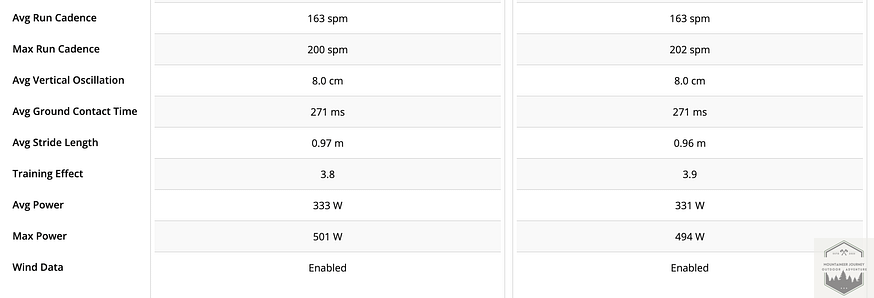
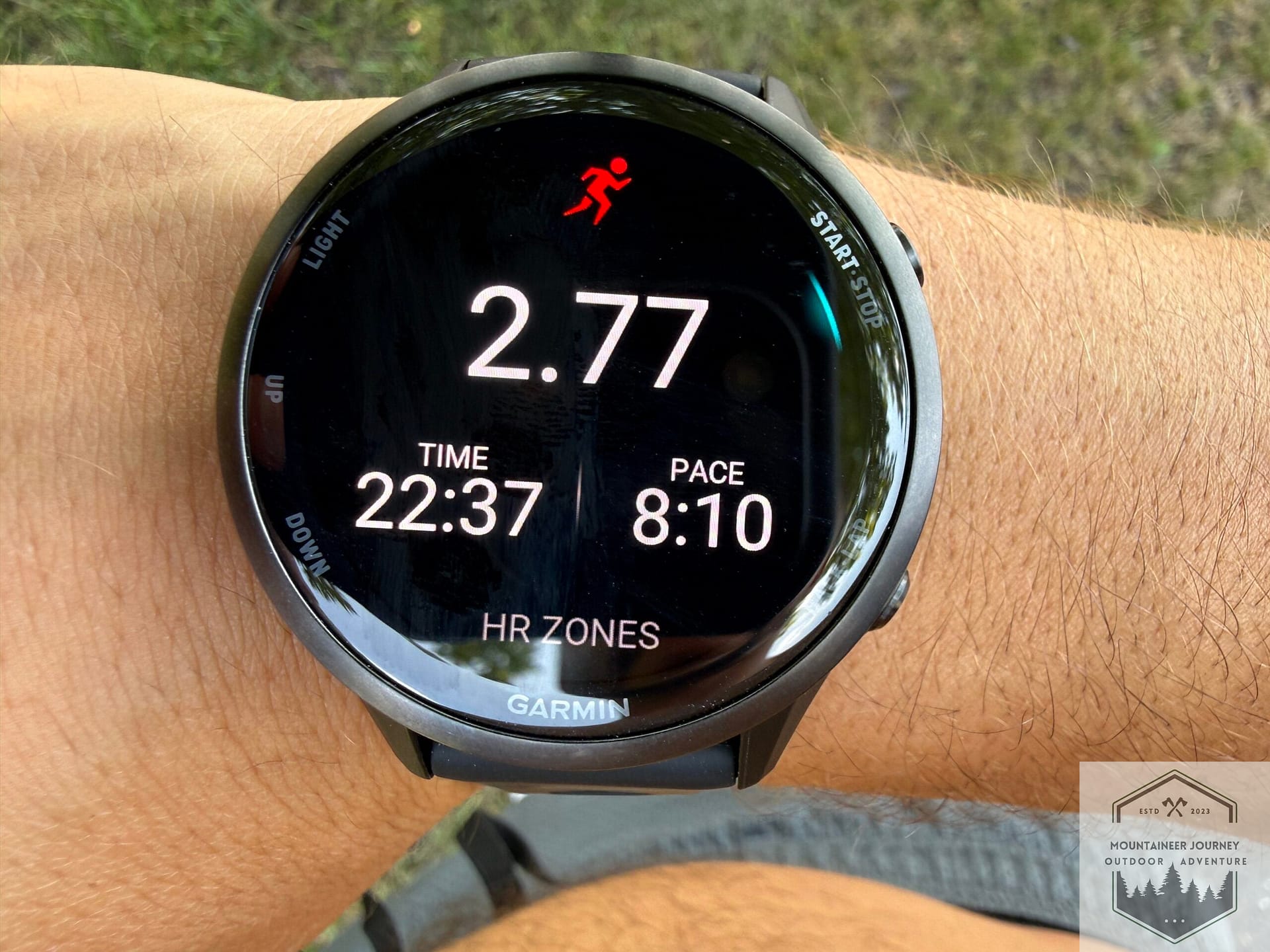
During the same 5-mile interval run, the running dynamics on both watches are nearly identical. Both have nearly the same cadence, vertical oscillation, stride length, and ground contact time.
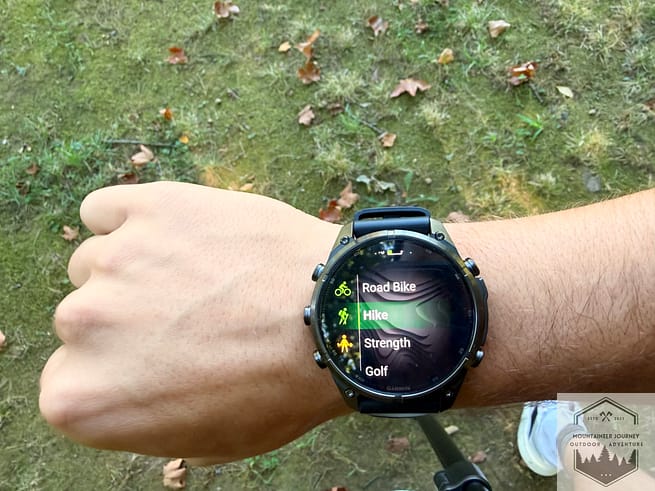
When it comes to top-of-the-line features, the Fenix 9 and Forerunner 970 have over 90 sport profiles and basically any sort of activity that is trackable, both watches have you covered.
For Golfing
Both the Fenix 9 and Forerunner 970 have over 43,000 preloaded golf courses, as well as yardage to green, pin position, and digital scorecards. However, one helpful feature I found useful, exclusive to the Fenix 9, was the pin pointer, which is a compass-like feature that points exactly towards the pin on the green, especially when you are hitting far away from the pin and have no idea where it is. This helped me line up my shots much better.
For somebody who’s a multisport athlete, or needs a watch that has some of the most sought-after tracking features, both the Fenix 9 and the Forerunner 970 deliver very well.
Forerunner 970 Activity Tracking & Training Score: 4.5 out of 5
Fenix 9 Activity Tracking & Training Score: 5 out of 5
Winner: Fenix 9
Battery Life: 20%

Battery life is where the Forerunner 970 and the Fenix 9 start to separate. During my testing, I found the Fenix 9 lasted up to 17 days in smartwatch-only mode and the 970 up to 15 days. But you aren’t here to only use these watches in smartwatch-only mode; activity-dependent battery life is the real data.
Regarding the Forerunner 970, I had approximately 5 days of battery life with 1-2 GPS workouts per day(Auto-select mode) and the brightness turned down to 1/3 with Always-On Display. The Fenix 9 no longer has Auto-select mode; however, with Max Accuracy mode, with 1-2 GPS workouts per day, I was getting around 6 days of battery life.
Max accuracy mode is only available on the Fenix 9 and uses the strongest multi-band GPS signal (without switching to single-band even if feasible), but it provides the highest accuracy while draining the most battery power. With activity mode (normal) on the Fenix 9(balancing battery life), I was getting closer to 7 days of battery life with 1-2 GPS workouts per day.
| Forerunner 970 Battery Mode | Battery life | Fenix 9 Battery Mode | Battery Life |
| Smartwatch Mode | 15 days | Smartwatch Mode | 17 days |
| Always-On Display(1/3 brightness) – 1-2 GPS workouts per day | 5 days | Max Accuray Mode: Always-On Display(1/3 brightness) 1-2 GPS workouts per day | 6 days |
| Multi-Band GPS | 20 hours | Activity Mode: Normal: Always-On Display(1/3 brightness) 1-2 GPS workouts per day | 7 days |
| Multi-Band GPS (Auto-select) | 22 hours |
Our testing chart shows that the Fenix 9 offers about 1 to 2 more days of battery life during heavy activity than the Forerunner 970. Additionally, the Fenix 9 features an expedition mode that the Forerunner 970 lacks.
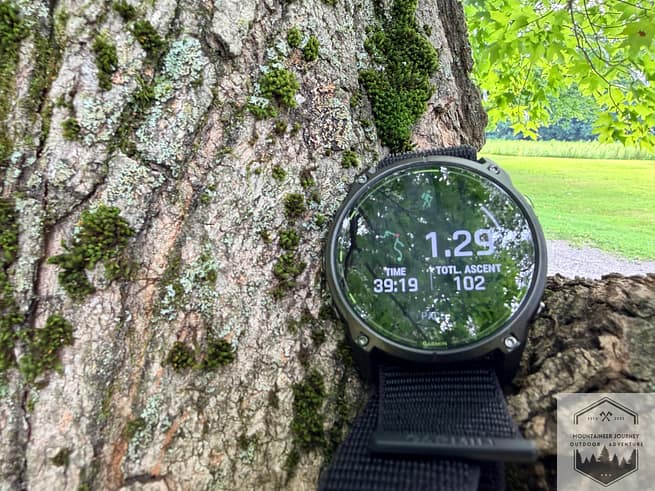
This mode adjusts the settings to their lowest levels—except for navigation—making it ideal for backcountry adventurers who require long battery life while still having navigation support on extended outings.
Overall, if you want the most battery life between these two, the Fenix 9 definitely has more juice.
Forerunner 970 Battery Life: 4 out of 5
Fenix 9 Battery Life: 4.5 out of 5
Winner: Fenix 9
Everyday Use: 10%
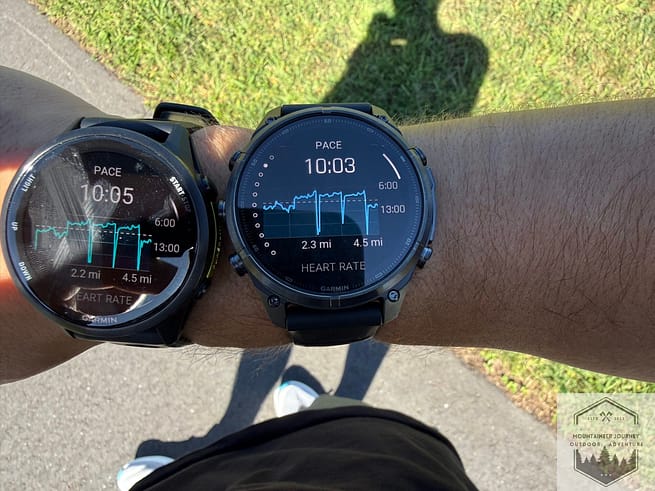
Everyday use for both watches will come down to wrist compatibility and preference. The Fenix 9 comes in 43, 47, and 51mm watch faces. We tested the 47 mm, which is the only option available for the Forerunner 970. Both have 1.4″ displays.
The Fenix 9, despite having the same 47 mm watch face, feels significantly bulkier on the wrist due to its heavier case. It weighs approximately 20 grams more than the Forerunner 970. While weight may not be a major concern, I found the Fenix 9 much bulkier and, during my testing, I often accidentally pressed the left middle button while extending my wrist—something that doesn’t happen with the Forerunner 970, since it lacks this button.
Additionally, I found the Fenix 9 less comfortable to wear while sleeping, as its bulkiness pressed into my wrist. In contrast, the Forerunner 970 is thinner, sleeker, and more subtle, making it much more comfortable to wear overnight.
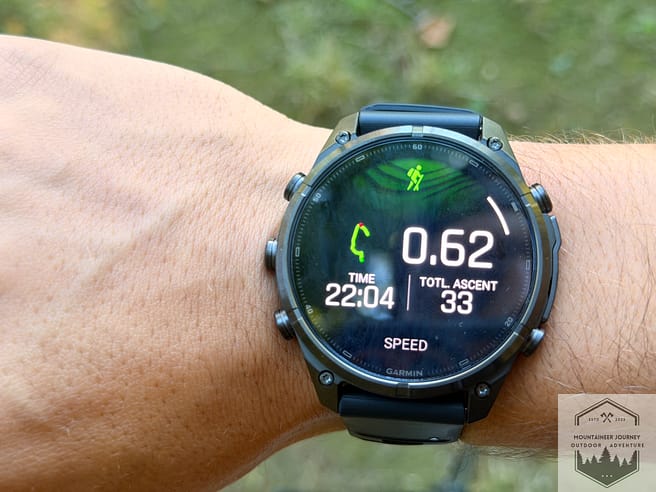
For display readability, the Forerunner 970 is much better. Garmin says the Fenix 9 has up to 3,000 nits, but doesn’t specify the 970’s nits.
Overall, the Fenix 9 is much harder to use for everyday tasks when you’re not exercising. I believe many people will like the brighter screen and more subtle feel of the Foreunner 970.
When it comes to everyday use, the 4090 is a lot more sleek and subtle with a brighter screen, while the Fenix 9 is much more bulky and tougher to wear when not using it for acitivies.
Forerunner 970 Everyday Use: 5 out of 5
Fenix 9 Everyday Use: 4 out of 5
Winner: Forerunner 970
Price and Value: 10%
The Forerunner 970 currently retails for $749, while the Fenix 9 (depending on watch size/InReach add-on) starts at $999 and can go up to $1,299 depending on the watch face and additional features.
For $450 more than the Forerunner 970, I added the Garmin InReach to my Fenix 9 Pro. This is a two-way satellite messaging system, plus SOS alerts you can use via your watch, rather than buying a separate $300-$400 satellite communicator.
While this is a steep price, this is perfect for backcountry hikers who no longer have cellular service but can send live track updates to family and friends, as well as send out an emergency SOS in case of an emergency on their Fenix 9 Pro. Currently, this is the only Garmin watch that has inReach capability.
Now, setting aside inReach, the Fenix 9 doesn’t have many more features than the Forerunner 970. The extra golf settings, perspective view, and stamina zones on the Fenix 9 are nice little features, but I don’t see them justifying paying anywhere from $250 to $550 more than the Forerunner 970.
The Fenix 9 does have double the storage space (64 GB vs 32 GB on the Forerunner 970),but typically, I do not have to store more than 30 GB of maps on my Forerunner 970. I will delete them after I’m done with that trail and/or road run. The extra storage space on the Fenix 9 is nice, but it’s more for those who like to download music onto their watch.
Overall, the $250-550 price increase on the Fenix 9 Pro is harder to justify based on these parameters. Of course, if you are going to be using Garmin InReach as a backcountry user and want more storage space and a longer battery life, the Fenix 9 makes more sense, but for the recreational runner or multisport athlete, I don’t think activity tracking in training is that much more superior than the Forerunner 970.
Forerunner 970 Price and Value Score: 5 out of 5
Fenix 9 Price and Value Score: 4.5 out of 5
Winner: Forerunner 970
| Testing Category | Weight | Garmin Forerunner 970 | Garmin Fenix 9 | Winner |
|---|---|---|---|---|
| GPS & Heart Rate Accuracy | 25% | 5/5 | 5/5 | Tie |
| Maps & Navigation | 20% | 4.5/5 | 4.5/5 | Tie |
| Activity Tracking & Training | 15% | 4.5/5 | 5/5 | Fenix 9 |
| Battery Life | 20% | 4/5 | 4.5/5 | Fenix 9 |
| Everyday Use | 10% | 5/5 | 4/5 | Forerunner 970 |
| Price & Value | 10% | 5/5 | 4.5/5 | Forerunner 970 |
| Weighted Overall Score | 100% | 9.3/10 | 9.3/10 | Fenix 9 |
Garmin Fenix 9 Overall Score: 9.3/10
Garmin Forerunner 970 Overall Score: 9.2/10
Forerunner 970 vs Fenix 9 | Which One Is Better Overall?
You may come away with this thinking that the Fenix 9 is much better than the Forerunner 970. While it does have double the storage, 1-2 more days of battery life, and further premium training features, it really isn’t all that far from the Forerunner 970.
This really comes down to how you’ll be using your watch on a daily basis. Choose the Fenix 9 if you want more battery life,InReach capability, further running features, and a more rugged look for extended hikes and treks.
The Forerunner 970 is more appealing to the everyday fitness enthusiast who doesn’t need to go several days without charging their watch, or very detailed topographic maps. The Forerunner 970 matches the Fenix 9 tit for tat on most running features, navigation, and mapping.
However, at the end of the day, the Fenix 9 is the more premium and capable watch based on our objective scoring. Choose the watch that best fits your use case.
| Comparision | Product | Rating | Price |
|---|---|---|---|
| 9.3 | Check Lowest PriceRead Review | |
| 9.2 | Check Lowest PriceRead Review |
How We Tested Our Methodology

I personally tested the Garmin Fenix 9 and Forerunner 970 to give you the most unbiased review possible. Mountaineer Journey is a 100% independent publisher with years of testing and reviewing outdoor equipment.
I don’t just read specifications from a sheet; I test these devices in real-world scenarios and provide visual data in our detailed reviews. We use our own coding software, developed specifically for GPS watch reviews on our website called Track Lab, to analyze heart rate and GPS accuracy.
This lets us present detailed comparisons between different watches, as well as with the Polar H10 chest strap, which we use as our baseline heart rate and cadence monitor.
We currently pay for the products we test ourselves; no company or manufacturer pays us to sway our opinions or decisions.

Tyler is the founder Mountaineer Journey and a professional Mountain Guide with 15+ years of technical experience in trekking, mountaineering, and trail sports. Having logged thousands of miles from rugged alpine summits to urban paths, Tyler provides rigorous, field-tested insights on hiking, walking, and trail running gear. All reviews are 100% unsponsored and unbiased, ensuring you get honest scoring based on real-world performance. His mission is to help outdoor enthusiasts of all levels find reliable equipment that ensures comfort, safety, and performance on any terrain.