Apple Watch Ultra 4 vs Garmin Fenix 9 Comparision | Unsponsored

| Comparision | Product | Rating | Price |
|---|---|---|---|
 | 9.2 | Check Lowest PriceRead Review | |
 | 8.4 | Check Lowest PriceRead Review |
Our Verdict
The Apple Watch Ultra 4 and Garmin Fenix 9 are both premium adventure watches tailored to fitness enthusiasts, but they are built for different people.
If you spend serious time in the backcountry and need full offline mapping, satellite messaging, and monster battery life, the Garmin Fenix 9 is the better tool. If you want a better everyday smartwatch that doubles as a capable fitness tracker and hiking companion for day trips, Apple’s latest watch is the one to wear.
I tested both high-spec watches over several weeks of trail runs, hikes, gym sessions, and daily wear, using the same weighted scoring rubric from our standalone reviews. I’ll draw on my 16 years of experience as a trail guide and expert outdoor gear reviewer to give the best recommendations based on objective testing data. I also run the MountaineerJourney YouTube Channel with 8,000+ subscribers and 4 million+ views.
The Fenix 9s have advantages in battery life, topographic navigation, inReach satellite safety, and deeper training metrics. The Ultra 4 closes that gap with comfort, iPhone integration, an easier user experience, free SOS alerts (the first two years), and a design that feels much more subtle on your wrist.
See our individual reviews of each: Garmin Fenix 9 review and Apple Watch Ultra 4 Review.
Related: Best Garmin GPS Watches
GPS and Heart Rate Accuracy: 25%

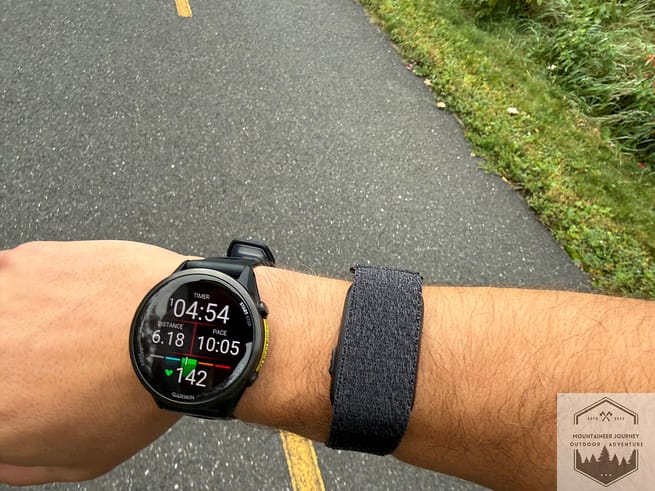
The Garmin Fenix 9 features the V5 optical heart rate sensor, while the Apple Watch Ultra 4 has its optical heart rate sensor powered by the new S11 chip.
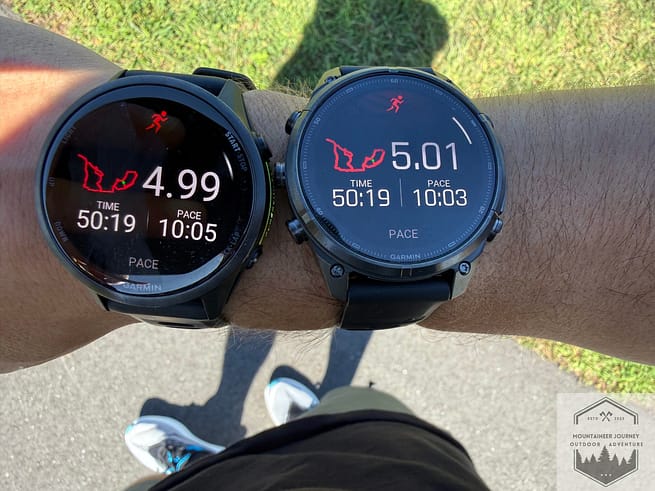
I tested both watches during an 8-mile interval run while wearing a Polar H10 chest strap for reference data. I then used my custom-built Tracklab software to compare the heart rate and GPS data.
| Apple Watch Ultra 4 vs Polar H10 8 Mile Run | Result |
|---|---|
| Cadence Lock | N/A |
| Fréchet Drift | 187.8 ft |
| Distance Over-Report | -3.2% |
| Multi-Watch Drift | 105.9 ft |
| Mean Absolute Error | 3.4 bpm |
| Root Mean Square Error | 4.6 bpm |
| Maximum Delta | -42.0 bpm |
| Bland-Altman Bias | +0.0 bpm |
| Lin’s Concordance | 0.807 |
| Interval Latency | 24.0 s |
| Fenix 9 vs Polar H10 8 Mile Run | Result |
|---|---|
| Cadence Lock Duration | LOCKED · 328s |
| Fréchet Drift | 157.4 ft |
| Distance Over-Report | -4.3% |
| Multi-Watch Drift | 53.8 ft |
| Mean Absolute Error | 5.9 bpm |
| Root Mean Square Error | 8.7 bpm |
| Maximum Delta | -28.0 bpm |
| Bland-Altman Bias | -3.2 bpm |
| Lin’s Concordance | 0.575 |
| Interval Latency | 10.5 s |
Looking at the data, the Ultra 4 watch was, on average, about 3.4 bpm off from the chest strap, compared to the Fenix 9, which was 5.9 bpm off the average. Interestingly, the Apple Watch Ultra 4 was a little late to the game for intervals, with a latency of 24 seconds compared to the Fenix 9’s tighter latency of 10.5 seconds.
While that may not seem like much, it is a big difference for those doing tighter 30-second to 1-minute intervals and needing quicker access to accurate heart rate results; the Fenix 9 seems to respond faster to interval changes.
Another interesting data point I gathered was that both watches severely underreported heart rate at different points in the run. The maximum delta of the Apple Ultra 4 was off by an astounding 42 bpm, while the maximum delta on the Fenix 9 was at 28 bpm. This typically happens at the beginning of a run, when the cadence lock kicks in and misrepresents heart rate during steps-per-minute.
Both watches were extremely accurate on the 8-mile course, while the Fenix 9 was slightly more accurate in total drift and distance. Keeping the distance report within ±5% is typically above average for all the watches we have tested.
Heart Rate data: Fenix 9 vs Polar H10

Heart rate data: Apple Watch Ultra 4 vs Polar H10

Overall, both watches are extremely accurate based on our testing results. GPS and total distance accuracy are among the best in class when you compare all GPS watches. For those doing very quick, shorter intervals, based on our previous Fenix 9 data and testing, the interval latency seems quicker than most watches.
Garmin Fenix 9 GPS & Heart Rate Accuracy: 5 out of 5
Apple Watch Ultra 4 GPS & Heart Rate Accuracy: 5 out of 5
Winner: Tie
Maps & Navigation: 20%

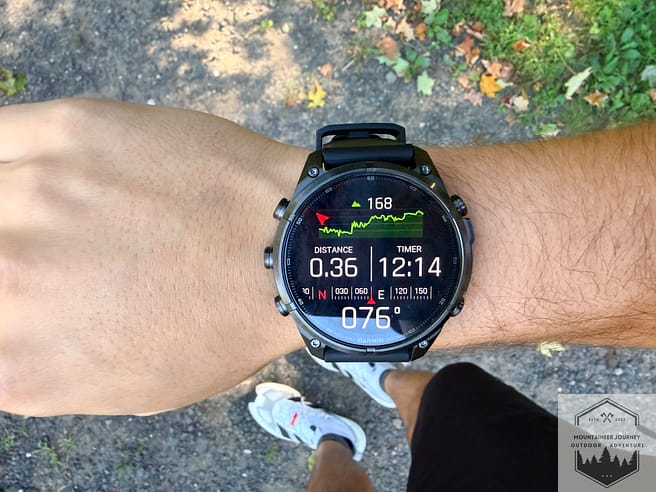
This is where the big differences between these two watches show up for hikers and trail runners. The Garmin Fenix 9 has detailed TopoActive maps, ClimbPro for gradient tracking, turn-by-turn routing, Nextfork navigation, and off-route alerts. All of this works offline.
The detailed topographic maps on the Fenix 9 are the best among Garmin GPS watches and other GPS watches we have tested. The RAM increased by 50% compared to the Fenix 8, and you can definitely feel the difference when panning and zooming on the maps. While rendering isn’t significantly faster, performance is much smoother and less clunky than in the previous version.
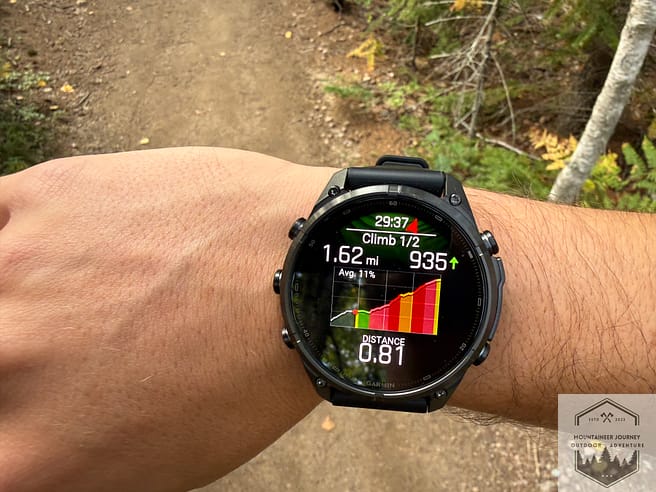
During my testing, one of my favorite glances to use on the Fenix 9 is Climpro, which gives you an idea of the total elevation you’re climbing and where you’re at currently in that climb (with red, yellow, and green zones to show how much of an increase in gradient you’re about to reach).

Another useful feature on the Fenix 9 for mapping and navigation is perspective view. It gives you a better idea of the upcoming terrain than a top-down view on the watch, with clearer contour lines and gradient changes.
The Apple Watch Ultra 4 offers offline maps for navigation; however, these maps don’t provide true topographic detail, contour lines, or trail data like Garmin. While Apple Maps does offer detailed routing for popular trails and national parks, it feels like using Apple Maps for driving navigation, which many Apple users are already familiar with.
To get anything close to a usable trail navigation experience, I had to rely on third-party apps like Workoutdoors or Footpath, which support GPX routes you can download directly to your phone. For this, I chose AllTrails GPX routes while testing both to keep the navigation data consistent for both the Fenix 9 and Ultra 4. Compared to the Apple Watch Ultra 3, the rendering is much quicker and seamless.
I ended up using Workoutdoors for most of the routing. The screen glance for the topographic map view isn’t as detailed as the Fenix 9, and it doesn’t have the bright, contrasting colors for easier readability.
You also have to switch between the activity app on the Apple Watch and Workoutdoors, as it is not an all-in-one application like on the Fenix 9. I found a trick on the trail: asking Siri to switch between Workoutdoors and my Activity app, which was pretty easy and seamless.
The turn-by-turn navigation was accurate on Workoutdoors. It does have off-road alerts, but they weren’t as responsive as the Fenix 9’s turn-by-turn navigation. The Ultra 4 shows a small glance at the bottom of the screen while using Workoutdoors, similar to Climb Pro showing elevation data, but it is not as easy to read, and it doesn’t show the distance between each drastic elevation change.
Panning and zooming on the Fenix 9 via physical buttons felt more usable while hiking than the Ultra 4’s touch-first interface, which required more deliberate interaction by me during testing.
The Apple Watch Ultra 4 can guide without a live phone connection, but the overall navigation experience falls well short of what the Garmin watch delivers in remote terrain. Relying on third-party apps can be frustrating, especially since they aren’t as clean, easy to use, or reliable as the Fenix 9’s built-in navigation.
Apple Watch Ultra 4 Maps and Navigation: 3.5 out of 5
Garmin Fenix 9 Maps and Navigation: 4.5 out of 5
Winner: Garmin Fenix 9
Activity Tracking & Training: 15%
Both devices offer advanced fitness tracking, but their strengths reflect different design philosophies. These are not watches that just count steps. Both track running dynamics, hiking profiles, gym work, and a long list of sport modes. But each one leans toward a different type of athlete.
The running dynamics and sport profiles are easy to use on both. During interval sessions, I found it easier to switch between segments to track my pace while quickly switching intervals on the Ultra 4 than on the Fenix 9.

The Apple Watch Ultra 4’s readiness scoring gives a helpful snapshot of recovery, but I found the Fenix 9’s training guidance more useful when I was stacking hikes, trail runs, and strength sessions across the week. Apple’s workout experience feels more familiar and flexible, especially if you already use an iPhone, while Garmin gives you more specific tools for judging endurance and how your body is handling demanding terrain.
On the Fenix 9, there are simply more data points, especially if you’re interested in deep, insightful metrics and a wider range of training data.
Stamina zones are a new, useful tool for runners and other athletes. They take into account current pacing and effort from previous workouts and give you an idea of how long you can hold a specific intensity (such as a pace) and how much you have left in the tank before you burn out. I found this useful while training for my races because it gives me unemotional raw data on what I want my splits to be.
Overall, both watches have great activity and customizable training stats.The Apple Watch Ultra 4 is a little bit easier and more streamlined to use. However, the Garmin Fenix 9 definitely has more options and training profiles that are much more tailored to the sport you are tracking.
Apple Watch Ultra 4 Activity Tracking & Training Score: 4.5 out of 5
Fenix 9 Activity Tracking & Training Score: 5 out of 5
Winner: Fenix 9
Battery Life: 20%

The biggest discrepancies between battery life in both these watches is what really draws the line in this review.. The Apple Watch Ultra 4 offers up to 50 hours of battery life in normal use and up to 18 hours of GPS use.
In my mixed-use testing with the Ultra 4, with always-on display, one-hour GPS workout, notifications, and sleep tracking running from about 4:30 a.m. to 9 p.m., the watch drained roughly 1.7 percent per hour, projecting to about 59 hours on a full charge. In low power mode while hiking, I saw closer to 52 hours, but that came with trade-offs like losing the always-on display and notifications.
The Garmin Fenix 9 is a different animal. With one to two GPS workouts per day, an always-on display, and reasonable brightness, it lasted about six days in my testing.
The Garmin Fenix 9 offers up to 54 hours in activity mode and up to 29 days in smartwatch mode if you turn off GPS and reduce brightness. Garmin also offers more battery life in larger models. Charging from under 20 percent to full took about 85 minutes.
The Fenix 9 is better for multi-day outdoor training because you can stretch through a three- or four-day backpacking trip without packing a power bank, which is something the Apple Watch Ultra 4 simply cannot do. The Apple Watch Ultra 4 needs to be charged every day.
Overall, the Fenix 9 has much better battery life than the Ultra 4. You can also consider the Solar Edition of the Fenix 9 with an MIP display for even better battery life.
Apple Watch Ultra 4 Battery Life: 3 out of 5
Garmin Fenix 9 Battery Life: 4.5 out of 5
Winner: Garmin Fenix 9
Everyday Use: 10%

The Apple Watch Ultra 4 weighs 62 grams, with a stack height of roughly 12.6 mm, and it sat comfortably on my wrist and was easy to use throughout the day. Overall, out of most GPS watches, the Apple Watch Ultra 4 sits on your wrist the easiest and is way more subtle than the Fenix 9.
The Fenix 9 Pro I tested at 47 mm has a stack height of about 15.2 mm with side buttons that protrude roughly 5.7 mm. That bulk matters. I accidentally pressed the left middle button on the Fenix 9 while flexing my wrist more times than I would like, which became genuinely annoying during everyday wear and while sleeping. The Fenix 9 also pressed into my wrist at night in a way the Ultra 4 never did.

Apple Watch Ultra 4 is better for iPhone users who want one watch that handles notifications, calls, Apple Pay, and a smooth touch interface without friction. Messaging is much easier than on the Fenix, especially for Apple users.
The Fenix 9 handles daily wear fine and supports Garmin Pay and Garmin Connect for data syncing, but for the average person who splits time between trail and town, the Ultra 4 is the more comfortable, usable daily companion.
If you want a more subtle watch that is comfortable in all settings, the Apple Watch Ultra 4 is the easy winner here.
Apple Watch Ultra 4 Everyday Use: 5 out of 5
Garmin Fenix 9 Everyday Use: 4 out of 5
Winner: Apple Watch Ultra 4
Price and Value: 10%
The Apple Watch Ultra 4 retails for $799. The Garmin Fenix 9 starts at $999; the Garmin Fenix 9 Pro with inReach in the 47 mm size runs $1,199, and the largest model at 51 mm, with solar and inReach, is $1,299.
For the extra money on the Fenix, you gain full offline mapping with TopoActive maps, optional inReach satellite messaging and SOS, about four more days of battery between charges with daily GPS use, and deeper training tools and options.
For $400 less than the Ultra 4, you get a more comfortable titanium watch body, stronger daily smartwatch features, tight iPhone integration, and enough performance for day hikes, trail runs, and weekend warriors who come back to a charger most nights.
For emergency SOS alerts, both watches offer satellite emergency alerts. However, the Fenix 9 requires the InReach add-on, which costs $100 plus a monthly subscription fee. The Apple Watch does include SOS alerts in limited countries, such as the U.S., the UK, Canada, and a few other select countries. Currently, this is free for the first 2 years on the Apple Watch.
Overall, it really comes down to what you will typically be using each watch for. Both the Fenix 9 and the Ultra 4 have great activity profiles, but the biggest differences are better navigation and longer battery life. With that, you do pay a higher price.
Apple Watch Ultra 4 Price and Value: 4.5 out of 5
Garmin Fenix 9 Price and Value: 4 out of 5
Winner: Garmin Fenix 9
| Testing Category | Weight | Apple Watch Ultra 4 | Garmin Fenix 9 | Winner | |
|---|---|---|---|---|---|
| GPS and Heart Rate Accuracy | 25% | 5/5 | 5/5 | Tie | |
| Maps and Navigation | 20% | 3.5/5 | 4.5/5 | Garmin Fenix 9 | |
| Activity Tracking and Training | 15% | 4.5/5 | 5/5 | Garmin Fenix 9 | |
| Battery Life | 20% | 3/5 | 4.5/5 | Garmin Fenix 9 | |
| Everyday Use | 10% | 5/5 | 4/5 | Apple Watch Ultra 4 | |
| Price and Value | 10% | 4.5/5 | 4/5 | Garmin Fenix 9 | |
| Weighted Overall Score | 100% | 8.4/10 | 9.3/10 | Garmin Fenix 9 |
Garmin Fenix 9 Overall Score: 9.3/10
Apple Watch Ultra 4 Overall Score: 8.4/10
| Comparision | Product | Rating | Price |
|---|---|---|---|
| 9.2 | Check Lowest PriceRead Review | |
| 8.4 | Check Lowest PriceRead Review |
Apple Watch Ultra 4 vs Garmin Fenix 9: Which Should You Buy?

Both watches are excellent, but they are optimized for different priorities. When you put these watches head to head, the decision framework is straightforward: how much time do you actually spend off grid, and how important is daily comfort versus extra metrics and need for SOS alerts?
Choose the Garmin Fenix 9 if you spend real time in the mountains, need multi-day battery life, care about full offline mapping with topo detail, and want inReach satellite safety for remote treks. The tradeoff is a bulkier watch and a higher price.
Choose the Apple Watch Ultra 4 if you use an iPhone, value comfort and a sleek design, and want strong health and fitness tracking with some outdoor and hiking features.
For hikers and trekkers, the Fenix 9 is the easiest choice because of its readability and structured mapping system. The Apple Watch Ultra 4 is still usable but has mapping quirks and relies on third-party integration.
How We Tested And Our Methodology

Mountaineer Journey is an independent review site. I buy our own gear, including both the Apple Watch Ultra 4 and the Garmin Fenix 9, and no company or manufacturer pays us to influence our opinions.
I wore each watch for weeks, logging GPS and heart rate data during hikes, trail runs, gym sessions, and everyday use, and compared all the data against a Polar H10 chest strap as our baseline.
The hiking impressions came from real mountain trails with meaningful elevation gain, and I intentionally tested navigation on and off route with GPX tracks. For a deeper look at our approach, see our methodology page.


Tyler is the founder Mountaineer Journey and a professional Mountain Guide with 16+ years of technical experience in trekking, mountaineering, and running. Having logged thousands of miles from rugged alpine summits to training for half marathons, Tyler provides rigorous, field-tested insights on hiking, walking, and trail running gear. All reviews are 100% unsponsored and unbiased, ensuring you get honest scoring based on real-world performance. His mission is to help outdoor enthusiasts of all levels find reliable equipment that ensures comfort, safety, and performance on any terrain.