
Our Score
Apple Watch Ultra 3 Review | Worth It In 2026?
In this article, I’m sharing my HONEST Apple Watch Ultra 3 review for those wondering whether this adventure watch is WORTH IT in 2026.
The Apple Watch Ultra 3 was released in September 2025, marking Apple’s most ambitious push into serious outdoor territory with built-in satellite communications and dual-frequency GPS.
In this review, I meticulously recorded over 60 hikes and trail runs using the Apple Watch Ultra 3. This included a range of environments, such as multi-day backpacking trips, steep mountainous terrain reaching elevations of 12,000 feet, half-marathon training, dense forests, and challenging sub-zero winter hiking conditions.
I’ll go over accuracy, battery life, mapping and navigation, features and smartwatch integration, durability, and, of course, value.
I’ll be sharing my critical opinion backed by 16 years of experience as a trail runner, hiker, and runner.
This review is unsponsored. I bought and paid for the Apple Watch Ultra 3 myself to provide the most unbiased, objective testing and scores.
I will also be comparing the Ultra 3 to the Garmin Fenix 8, Coros Pace 4, and Garmin Vivoactive 6.
Should you buy the Apple Watch Ultra 3?

Buy if
- You want the longer battery life available in an Apple Watch (42 hours normal, up to 72 in low power mode)
- You are training for a race (half marathon, full marathon, 10k)
- You’re heavily invested in the Apple ecosystem and want seamless integration with your health app and fitness app
- You’re upgrading from the original Apple Watch Ultra or older Apple Watch Series models
DON’T Buy If
- You primarily hike off-grid and need full topographic maps.
- You need advanced offline maps and turn-by-turn trail navigation
- You’re happy with your Apple Watch Ultra 2 (the upgrade is incremental)
- You prefer dedicated GPS watches from Garmin, COROS, or Suunto with multi-day battery life
- You’re budget-conscious and don’t need Ultra-specific features like the satellite feature or dive computer capabilities
Compare Similar Products
| Comparision | Product | Rating | Price |
|---|---|---|---|
 | 7.8 | Check Lowest Price | |
 | 8.6 | Check LOWEST PriceRead Review | |
 | 8.1 | Check Lowest PriceRead Review |
Apple Watch Ultra 3 Pros and Cons
Pros
- Satellite messaging
- Dual-frequency GPS signal
- 5G connectivity with seamless integration
- Durable action buttons
Cons
- High price point ($799)
- 3rd-party apps for trail navigation
- GPS drains battery fast
Apple Watch Ultra 3 Price
At the time of this writing, the Apple Watch Ultra 3 is priced at $799.
Apple Watch Ultra 3 Accuracy: 30%

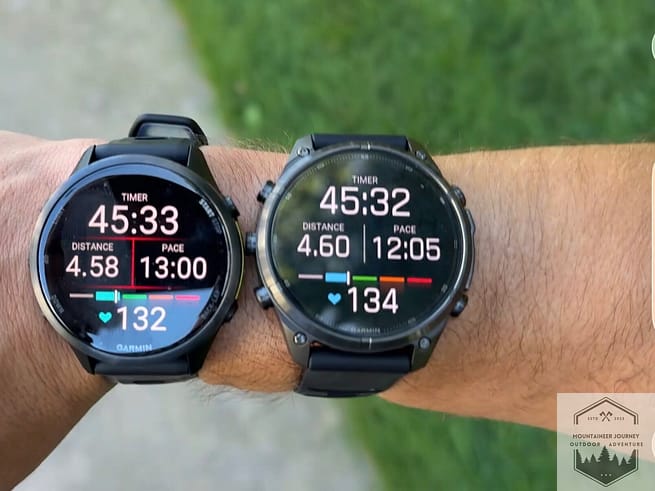
To keep my scoring objective, I compared heart rate readings from my Polar H10 chest strap with those from the Apple Watch Ultra 3 throughout my testing. I also benchmarked GPS against a handheld Garmin InReach Mini 3.
The dual-frequency GPS is where this watch really shines. In heavily dense, covered forests in the northeastern US, I noticed very little drift, if any, during my GPS testing.
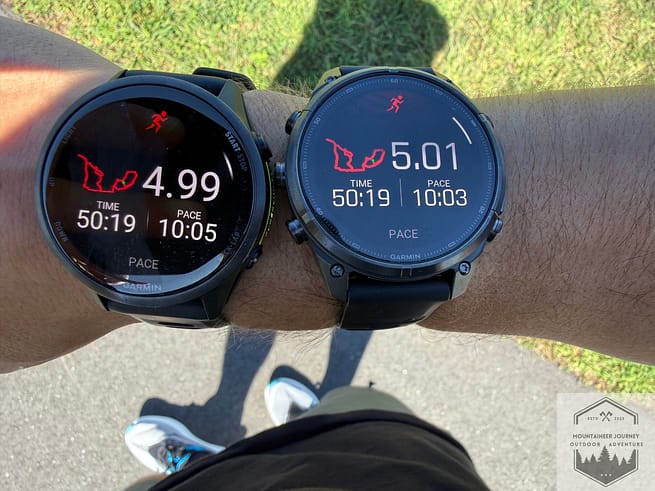
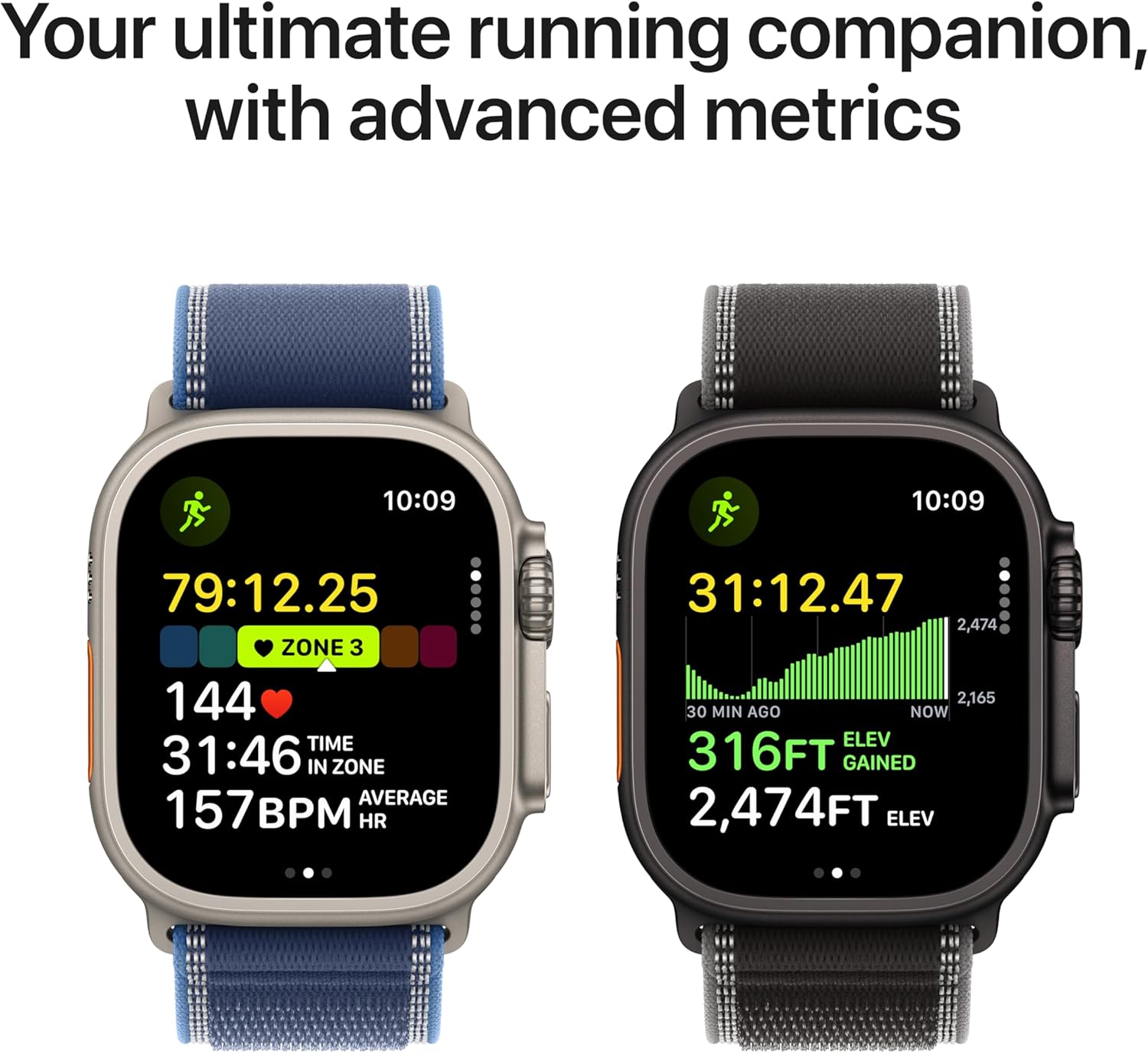
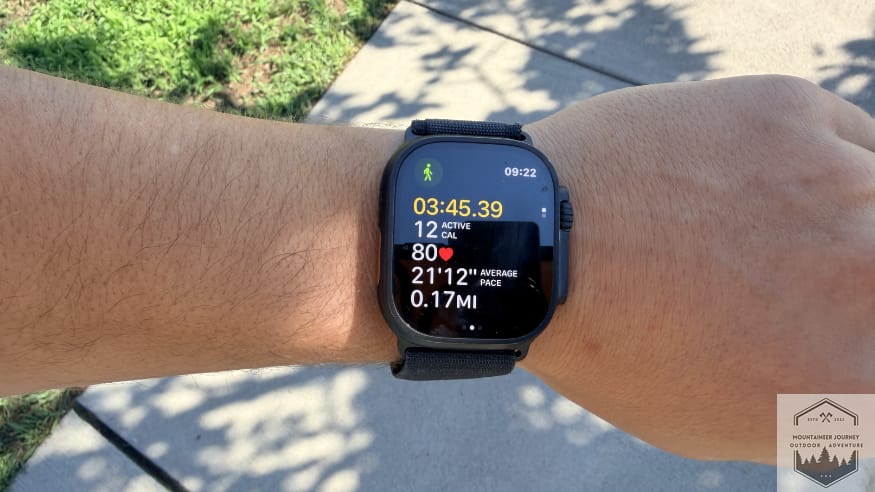
Regarding pace and GPS for running, I tested this during my half marathon training and while running my half marathon. During my half marathon, my average pace was off by just one second compared to the chip I wore.
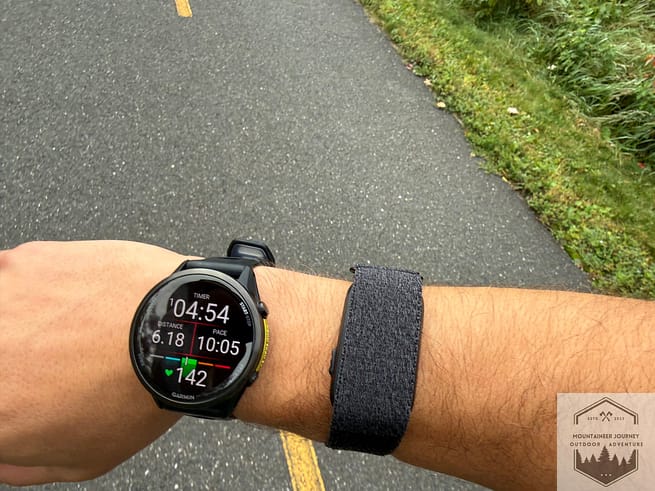
The heart rate accuracy demonstrated during rigorous testing was noteworthy. During a 4-mile trail run with substantial elevation changes, the optical sensor exhibited an average variance of only 1 BPM compared to the Polar H10 chest strap.
It is important to note, however, that heart rate accuracy varied with changes in elevation. A lag of approximately 5 seconds was observed between the watch readings and the Polar H10 strap, resulting in a discrepancy of 2 to 3 beats per minute compared with the chest strap data.
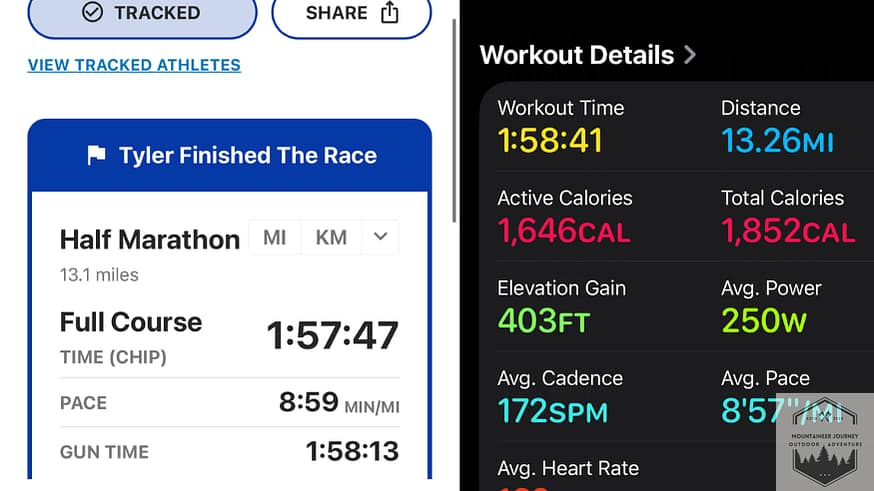
Elevation tracking via the altimeter was accurate within ±15-25 feet on hikes with over 4,000 feet of gain. This was slightly off from the Garmin Fenix 8, but still good enough for hiking elevation changes.
Where I encountered issues: Distance over longer trails (20-30 miles) was occasionally overestimated by 5-10% unless my mapping app used correction algorithms.
An additional concern I observed was elevated heart rates during intense running sessions. It is well established among athletes that heart rate can increase significantly in response to rising temperatures.
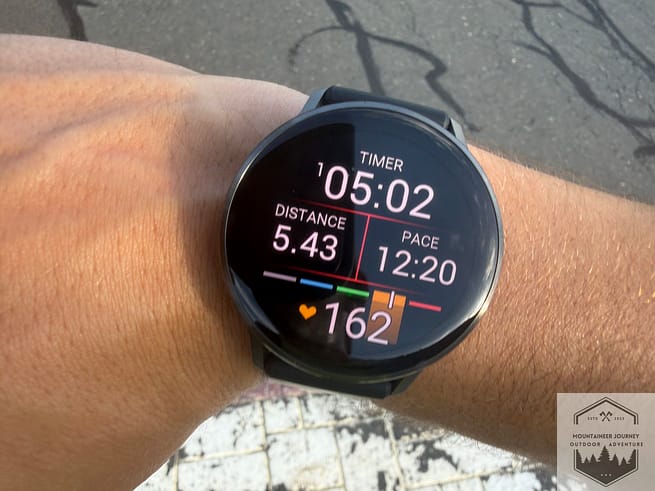
During my half marathon training in over 90°F. I noticed that the watch would tend to be off by 5-10 beats per minute, but would take about 4-5 minutes to correct itself.
Overall, in terms of accuracy, it is much better for runners and daily use than an extremely accurate GPS watch like the Garmin Fenix 8, which is designed more for outdoor adventures.
Accuracy Score: 8.5/10 (30%)
Battery Life: 20%

The battery life of the Apple Watch Ultra 3 represents a genuine improvement over previous models.
Apple claims 42 hours in normal use and up to 72 hours in low-power mode, and during my testing, these numbers were quite accurate.
During a recent backpacking trip with approximately 6 hours of hiking each day, along with GPS tracking, elevation monitoring, and occasional use of mapping features, the Ultra 3 device delivered approximately 36 to 38 hours of battery life before depleting to 5 to 10% remaining charge.
The most significant drain on the battery was observed while using the mapping application.
I found a constant 14-hour battery life in GPS-only mode. You can save approximately 20% more by going into eco mode only.
Low power mode is what really saves this watch. I noted an increase in battery life of approximately 24 hours when in low-power mode, with minimal change in performance.
Charging speed is excellent: This is definitely one of the fastest watches to get a nice, quick charge from almost 0% battery to 80%. I was fully charged within less than an hour.
In cold weather, typically below freezing (around 0-20°F), I observed a 20-30% increase in battery drain. This was especially noticeable as the brighter screen compensated for sunlight, and the sensors worked overtime.
Overall, this is not a multi-day-use watch (other than in low-power mode). It does require constant charging, especially if you’re using all the performance features it offers.
This is a crucial point to consider, as it can significantly change the buyer profile depending on the length of your adventure or sport.
Battery Life Score: 7.5/10 (20%)
Mapping & Navigation: 20%
The Apple Watch Ultra 3 provides mapping through Apple Maps; however, this remains its least developed feature for serious hiking applications.
While the built-in navigation performs adequately on roadways, it has limitations on off-road trails.
Apple Maps offers some offline functionality and utilizes a combination of map data and a nationwide trail database to enhance GPS positioning accuracy.
Nonetheless, detailed topographic trail information is frequently insufficient. Turn-by-turn guidance at trail intersections largely relies on third-party applications, as Apple Maps does not fully support many backcountry routes.
I tested extensively with third-party apps like WorkOutDoors, AllTrails, and Komoot. WorkOutDoors delivered smoother breadcrumb trails and more precise map views than Apple Maps’ sharply zoomed interface. However, offline maps require prior download, which adds time to pre-trip planning.
Route following for simple point-to-point trails works fine. For junctions, forks, and unmarked trails, the experience is less reliable.
The dual-frequency GPS does reduce drift significantly, making mapping more usable than on previous model watches, but it’s still not as precise as dedicated GPS units with full offline topo maps.
The satellite connectivity helps when you’re truly off-grid, allowing you to contact emergency services, share your location via Find My, and send messages.
However, the maps themselves still need to be preloaded. For remote areas where I needed absolute certainty about my route, I still carried my handheld GPS as backup.
The mapping accuracy following my workouts was notably reliable, particularly during my training for the half marathon. However, it is advisable to exercise caution when relying on the Apple Watch Ultra 3 for truly off-grid hiking.
Mapping & Navigation Score: 6/10 (20%)
Features & Training: 10%
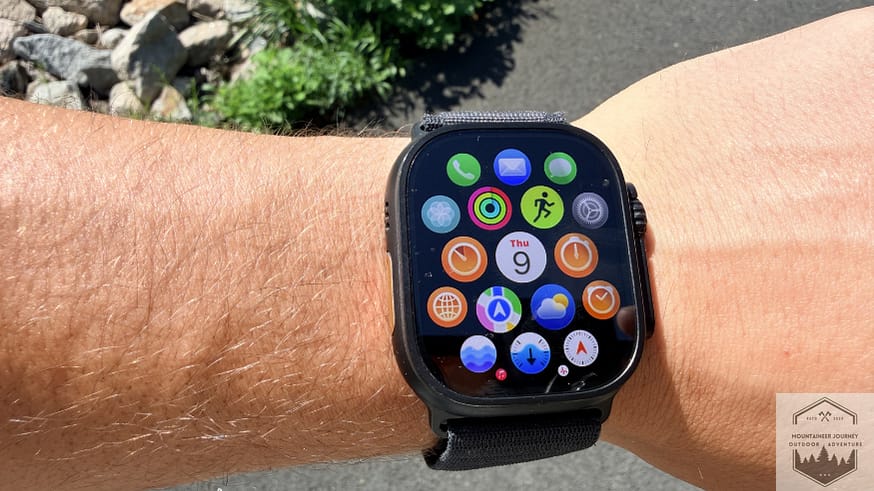
The features on the Apple Watch Ultra 3 can take a little getting used to. However, if you’ve used an iPhone before, this will be very seamless.
The Health App integration delivers multiple comprehensive tracking measures. Each workout action delivers different types of measurements.
For example, while training during my half marathon, I was able to note my cadence, which was extremely accurate, and then directly see how it affected my pace during each run.
Unlike the Garmin app, the Apple Health app is all-in-one, making it easy to see your results together rather than having to look up each piece of data, like cadence, heart rate, and stride length.
Sleep tracking was much more accurate than on the Coros Pace 4. It was the most accurate GPS watch for sleep, compared to my Oura Ring 4, in tracking deep and REM sleep.
The Action button remains excellent for quickly marking waypoints during hikes and trail runs. The digital crown and buttons worked reliably even with gloves in cold weather or even through water.
For example, I dumped some water on my head, which got onto my watch during a few of my runs, and the action buttons and even the screen worked seamlessly with water on them.
5G connectivity is new to ultra models, useful in urban to semi-rural areas but rarely helpful deep in the wilderness.
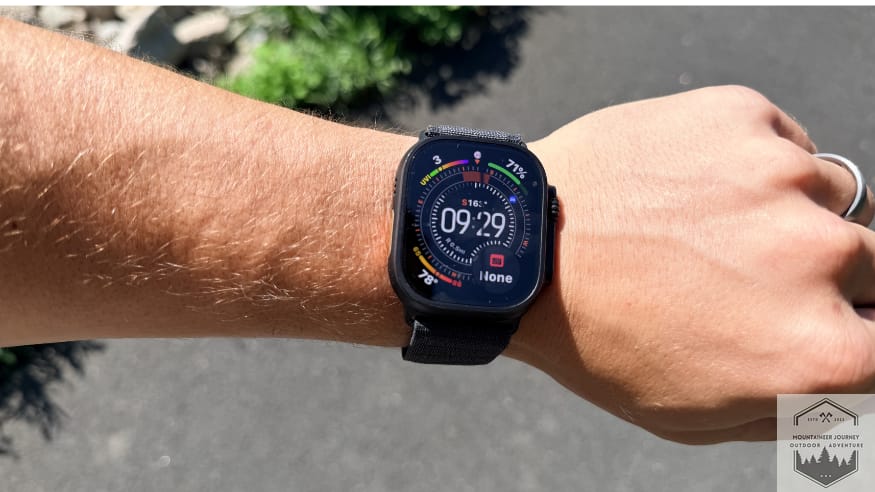
Watch face customization helps put relevant data front and center.
Integration with Apple Pay, the phone app, Control Center, and built-in features like fall detection, emergency call capability, and automatic notification of emergency contacts makes this feel like a complete system rather than just a GPS watch.
Features & Training Score: 9/10 (10%)
Versatility: 10%

I had a tough time scoring the Apple Ultra’s versatility. While it’s one of the best GPS watches for everyday use and running, it lacks accurate mapping and hiking capabilities.
In terms of build quality, its robust Grade-5 titanium case and sapphire crystal display provide durability for demanding environments, while the wide range of health sensors and smartwatch features cater to daily use.
The customizable Action button enhances usability by providing quick access to workouts, the compass, the dive app, or shortcuts, even when wearing gloves.
The large, bright display remains readable in both bright sunlight and low-light conditions, supporting a range of outdoor activities, from hiking and trail running to scuba diving.
The battery life is suitable for one- to two-day adventures, but nothing more.
Overall, the Ultra 3’s versatility makes it suitable for users who want a single device for both serious outdoor adventures and daily smartwatch needs.
Versatility Score: 8.5/10 (10%)
Is The Apple Watch Ultra 3 Worth It?
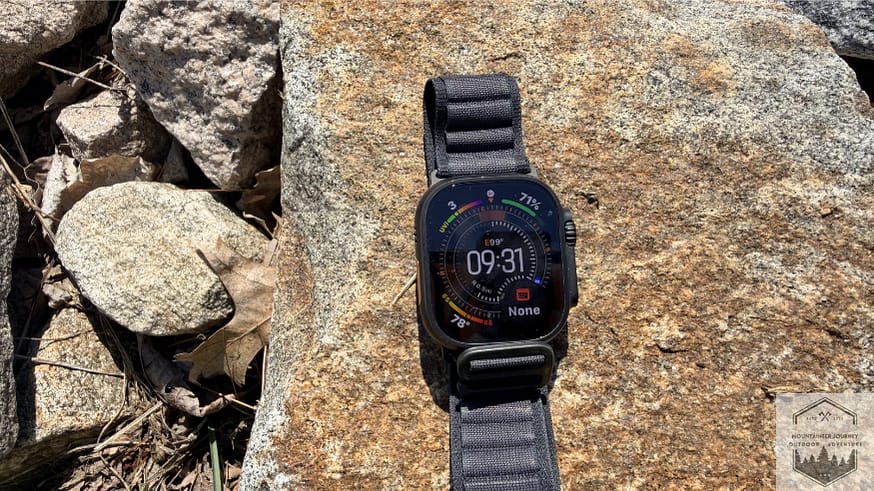
At $799, the Apple Watch Ultra 3 represents Apple’s flagship model for outdoor enthusiasts, and the value equation depends heavily on your specific needs.
If you’re upgrading from an older Series watch or the original Ultra, the combination of satellite connectivity, dual-frequency GPS, a brighter screen, and improved battery makes this feel like a true step up.
The built-in satellite communications alone provide peace of mind that no amount of cellular coverage can match in remote wilderness.
If you already own an Ultra 2 and are happy with it, the incremental gains may not justify another $799 (minus trade-in). You gain satellite messaging, slightly better GPS, and 5G—nice additions, but not revolutionary if your current new watch serves you well.
Compared to dedicated GPS watches from Garmin or COROS, the Ultra 3 offers superior smartwatch integration and advanced health-tracking capabilities, including a unique satellite communication feature.
However, it falls short in raw GPS battery endurance and the depth of offline mapping options.
While Apple continues to enhance its outdoor functionality, the Ultra 3 does not yet match the specialized performance and extended battery life offered by purpose-built sports watches for prolonged backcountry expeditions without access to recharging.
Long-term value looks solid: Apple typically supports devices for 5-7 years with software updates, and the accessory ecosystem is unmatched. Just know that battery capacity will degrade over time, and repair costs for the titanium and sapphire crystal are high without AppleCare.
For someone wanting top-notch accuracy and day-to-day smartwatch capability with deep Apple product integration, it’s hard to beat—even at this premium price.
Value (10%): 7.5/10
Scoring Breakdown
Accuracy (30%): 8.5/10
Battery Life (20%): 7.5/10
Mapping & Navigation (20%): 6/10
Features & Training (10%): 9/10
Versatility (10%): 8.5/10
Value (10%): 7.5/10
Total Weighted Score:
Total Score = 2.55 + 1.50 + 1.20 + 0.90 + 0.85 + 0.75 = 7.75 / 10
Our Rating: 7.8/10
Frequently Asked Questions
How long does the Apple Watch Ultra 3 battery last for hiking?
The Apple Watch Ultra 3 offers approximately 14-16 hours of battery life with continuous GPS and heart rate monitoring enabled. Using low-power mode with reduced sensor activity can extend battery life to approximately 20 hours of uninterrupted outdoor use. Under typical smartwatch conditions, the device provides up to 42 hours of battery life, which can be extended to 72 hours in low-power mode.
Does the Ultra 3 work for navigation without a cellular signal?
Yes, but with limitations. The GPS works independently of cellular service, and satellite connectivity allows emergency SOS, messaging, and location sharing. However, maps need to be pre-downloaded for offline use, and turn-by-turn trail navigation relies heavily on third-party apps rather than built-in Apple Maps.
Is the satellite connectivity worth the upgrade from Ultra 2?
If you frequently hike in areas without cellular service and require the capability to send messages or share your location when off-grid, the satellite connectivity feature is a valuable asset that enhances safety and communication during remote excursions. For users who predominantly remain within cellular coverage, the incremental benefits of upgrading for satellite functionality are considerably diminished.
Can I use it for multi-day backpacking trips?
Yes, with planning. A two-day trip with 6 hours of GPS use daily is comfortable on a single charge. For longer trips, you’ll need to bring charging capability or use low-power mode aggressively. Unlike some dedicated GPS watches with week-long battery life, the Ultra 3 requires more power management on extended trips.
How does it compare to Garmin watches for hiking?
The Apple Watch Ultra 3 beats most Garmin models in display quality, health sensor variety, and smartwatch integration. However, most Garmin models, such as the Fenix 8, are much more usable with offline maps and off-grid hiking.
What’s the difference between Ultra 3 and the regular Apple Watch for outdoor use?
The Ultra 3 offers approximately double the battery life, a significantly brighter 3,000-nit display, satellite connectivity, a larger, more durable titanium case with a sapphire crystal, deeper water resistance (100m vs 50m), dust resistance, MIL-STD-810H testing, and a programmable Action button.
How We Tested and Our Methodology
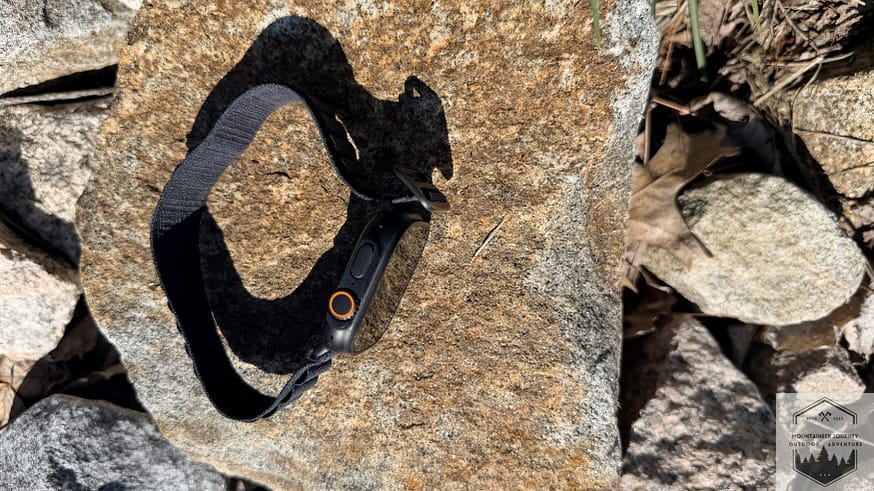
I personally tested the Apple Watch Ultra 3 from its September 2025 release through March 2026, with the sole intent of giving you the most unbiased review possible.
My testing included over 60 hikes and trail runs across varied terrain: steep mountainous climbs, dense hardwood forests, exposed alpine ridges, canyon sections, and high-altitude environments up to 12,000 feet. I also tested in temperature extremes from sub-zero winter conditions to summer heat.
Reference devices included a Polar H10 chest-strap heart rate monitor for accuracy benchmarking, a Garmin GPSMAP handheld, and pre-mapped GPX routes for distance and elevation verification.
Accuracy Testing
- Heart rate accuracy compared against Polar H10 chest strap during varied intensity activities
- GPS accuracy was double-checked against handheld GPS units and verified GPX routes
- I evaluated four key metrics: heart rate variance, distance error, GPS track quality, and elevation stability
Battery Testing
- Real-world battery drain measured during GPS workouts and general smartwatch use
- Tested across temperature ranges and varying usage intensities
- Scoring based on GPS duration, battery consistency, and overall longevity
Mapping and Navigation Testing
- Navigation scored on capability, not price point
- Tested both built-in Apple Maps and third-party apps in real trail conditions
- Evaluated breadcrumb tracking, route following, and offline functionality
Features, Durability, and Value
- Features evaluated based on outdoor relevance: satellite connectivity, health tracking, Action button utility
- Durability assessed through months of actual trail use in varied conditions
- Value considers price-to-performance ratio, long-term support, and comparison to alternatives
To ensure every review is consistent, I use the same scoring framework across all GPS watch reviews: Accuracy • Battery Life • Mapping and Navigation • Features • Durability • Value
That way, you can easily compare models side by side without worrying about different scoring rules for each one.

Tyler
Tyler is the founder Mountaineer Journey and a professional Mountain Guide with 15+ years of technical experience in trekking, mountaineering, and trail sports. Having logged thousands of miles from rugged alpine summits to urban paths, Tyler provides rigorous, field-tested insights on hiking, walking, and trail running gear. All reviews are 100% unsponsored and unbiased, ensuring you get honest scoring based on real-world performance. His mission is to help outdoor enthusiasts of all levels find reliable equipment that ensures comfort, safety, and performance on any terrain.