Our Score
Garmin Enduro 4 Review | Unsponsored

Our Verdict
The Garmin Enduro 4 is a GPS watch built for endurance athletes and backcountry hikers who refuse to carry a charger on multi-day treks. Released on October 9, 2026, at $899.99, the Enduro 4 sits between the older Enduro 3 (now around $799.99) and the Fenix 9 Pro Solar lineup ($1,100 and up).
The whole point of this Enduro watch has always been battery life, and the Enduro 4 delivers the same class-leading numbers as its predecessor: up to 320 hours of GPS with solar in extended battery mode and up to 90 days in smartwatch mode with solar charging.
The strengths here are real. Under-the-hood upgrades matter: 50% more RAM, a faster mapping engine borrowed from the Fenix 9, and 64 GB of onboard storage (doubled from the Enduro 3’s 32 GB).
But the drawbacks are just as real. The 51 mm case weighs 65 grams with the band, which is noticeably heavier and bulkier on your wrist than a Fenix 9. The MIP screen looks dull and washed out indoors compared to any AMOLED competitor. And there is no Garmin InReach, no LTE, no microphone, and no speaker, which means you still need a separate satellite communicator if you head far off grid.
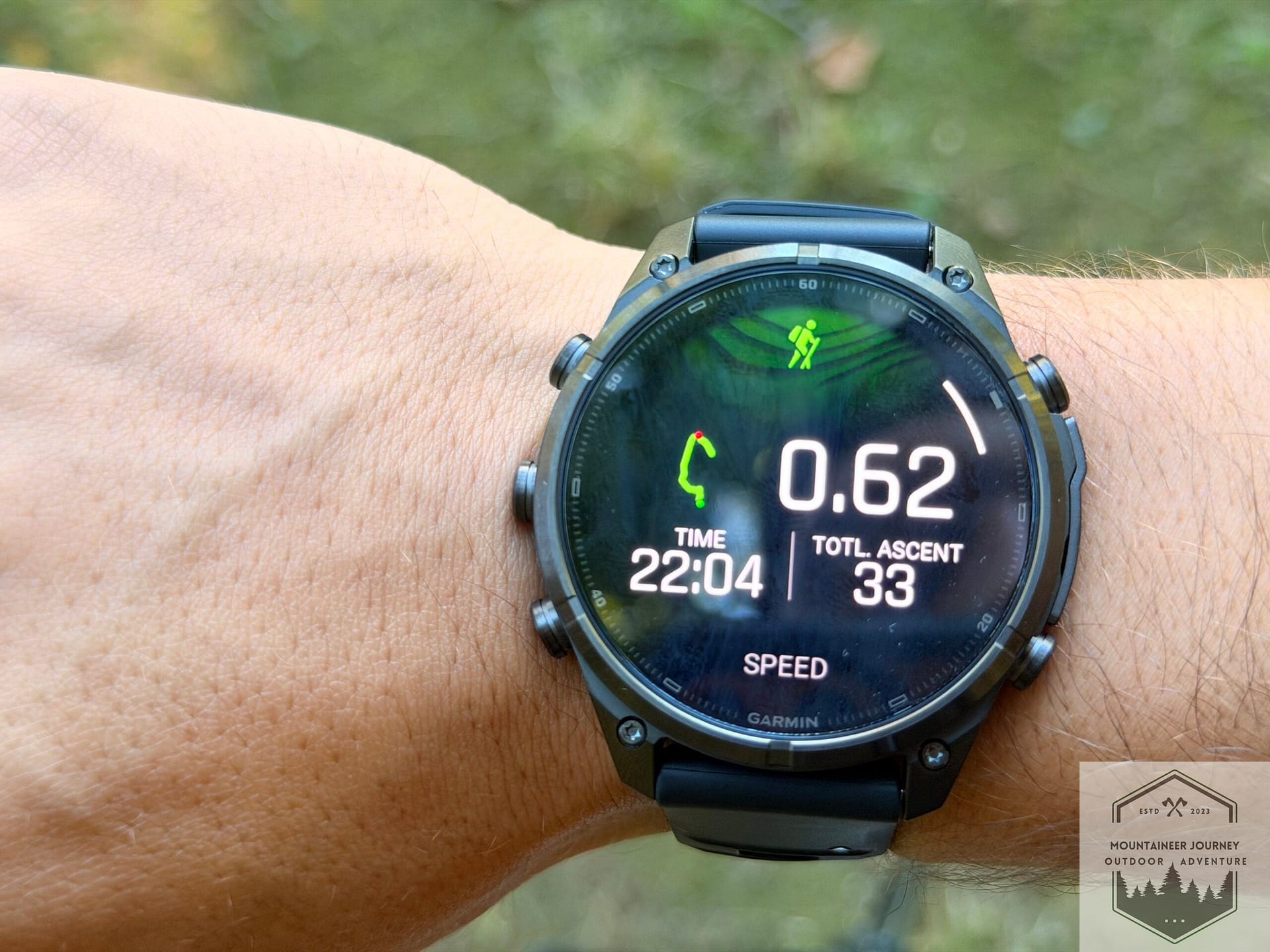
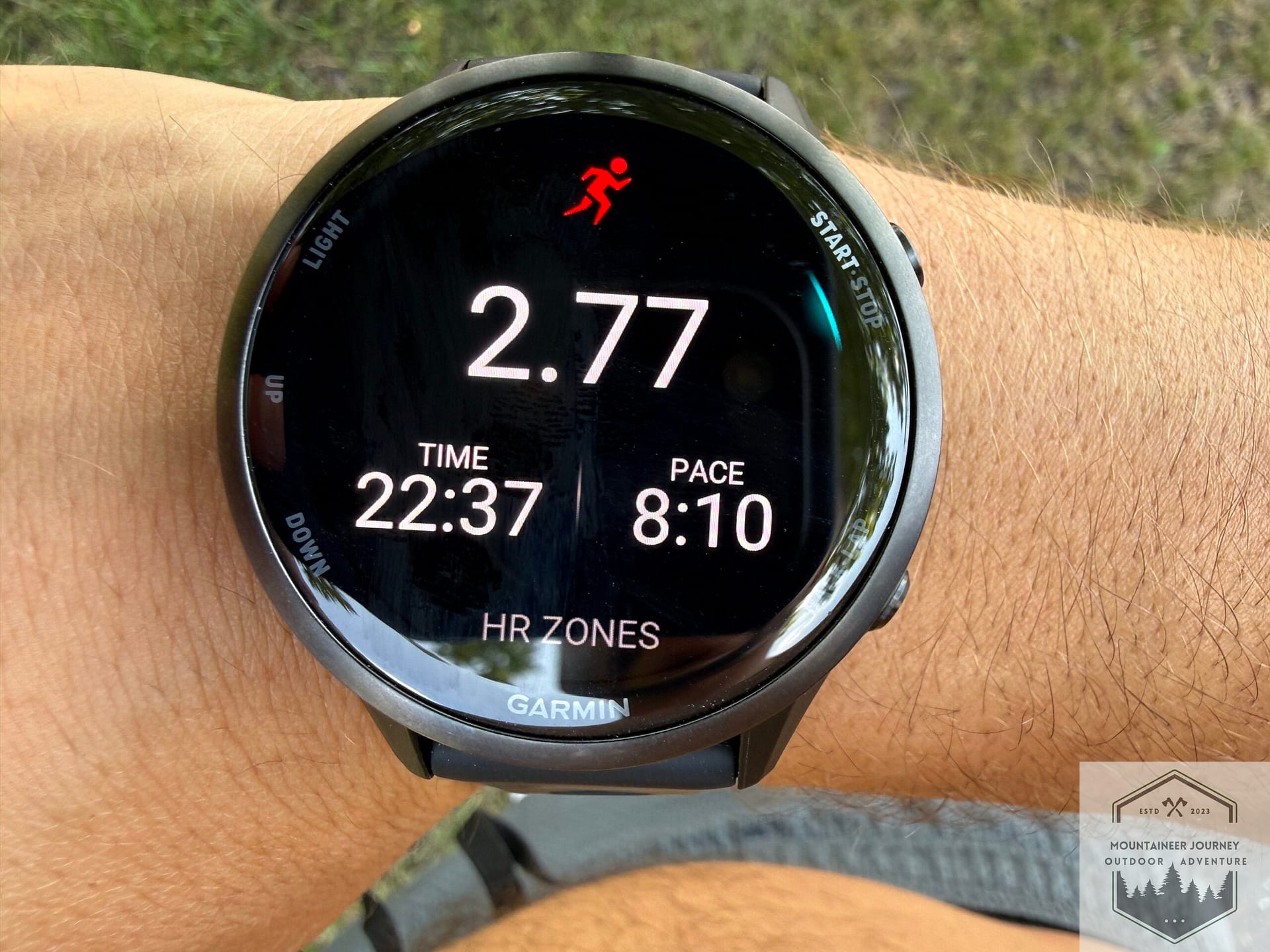
I bought the Enduro 4 myself, tested it on back-to-back 2-hour trail runs, and a backpacking loop through mixed forest and exposed alpine terrain, and daily wore it for three weeks straight.
All accuracy data ran through our Tracklab system. The verdict: if you are a trail runner or thru-hiker who lives for long unsupported days and wants a watch that outlasts your legs, the Enduro 4 earns its spot. If you split time between town and trail or want satellite messaging on your wrist, the Fenix 9 or Forerunner 970 is the better call.
Compare Similar Products
| Comparision | Product | Rating | Price |
|---|---|---|---|
 | 8 | Check Lowest Price | |
 | 8.9 | Check Lowest PriceRead Review | |
 | 8.5 | Check Lowest PriceRead Review |
As an independent reviewer, I purchase all products myself. Some links may be affiliate links that support the site at no cost to you
Should You Buy The Garmin Enduro 4?

Buy If
- You are a backcountry hiker or thru hiker who wants weeks of use when comes to battery life.
- You are an ultra runner or stage race athlete who needs reliable GPS logs and navigation for 20 to 50-hour efforts
- You actually prefer a transflective MIP display
- You are already in the Garmin ecosystem and want mapping and training metrics but prioritize longer battery life
Don’t Buy If
- You want on wrist satellite messaging and SOS capability in a single device; the Enduro 4 has no Garmin InReach, which means carrying a separate communicator for emergency contact off-grid
- You spend more time in town than on trail and prefer an AMOLED screen
- You have a small wrist or sleep in your watch and will find the 51 mm diameter and 16 mm thickness
- You already own an Enduro 3 with a healthy battery and do not care about faster maps, stamina zones, or doubled storage
Garmin Enduro 4 Pros and Cons

Pros
- Extreme Battery Life
- 10 ATM Water Resistance
- Faster Mapping Speed
- Built-In LED flashlight
Cons
- Very Bulky
- No Microphone
- Premium Price with smaller upgrades
Garmin Enduro 4 Price
The Enduro 4 is currently priced at $899.
Accuracy: 30%

Accuracy carries the most weight in our scoring because a GPS watch that cannot track your route or heart rate reliably fails at its core job. We measure accuracy using Tracklab, comparing Enduro 4 data against a Polar H10 chest strap worn simultaneously on every test outing.
For this review, the primary benchmark was a 4-mile run on mixed terrain: paved road transitioning to packed dirt singletrack with moderate tree cover and one short climb.
The numbers below are Enduro 4 versus Polar H10 for that 4-mile run.
Tracklab Results: Enduro 4 vs Polar H10 (4 Mile Run)
| Metric | Enduro 4 vs Polar H10 |
|---|---|
| Cadence Lock Duration | LOCKED · 25 s |
| Fréchet Drift | 56.8 ft |
| Distance Over Report | −0.9% |
| Multi Watch Drift | 105.3 ft |
| Mean Absolute Error | 6.0 bpm |
| Root Mean Square Error | 9.2 bpm |
| Maximum Delta | +30.9 bpm |
| Bland Altman Bias | −0.2 bpm |
| Lin’s Concordance | 0.544 |
| Interval Latency | 7.0 s |
Interpreting The Enduro 4’s Tracklab Data
A Cadence Lock Duration of 25 seconds means the Enduro 4’s optical sensor locked onto cadence rather than actual heart rate for the first 25 seconds of running.
In practice, this shows up as your heart rate reading matching your arm swing frequency at the start of an effort. After those 25 seconds, the sensor recalibrates and begins tracking actual pulse. For hill repeats or short intervals, that 25-second lock can eat into the first rep of your set.
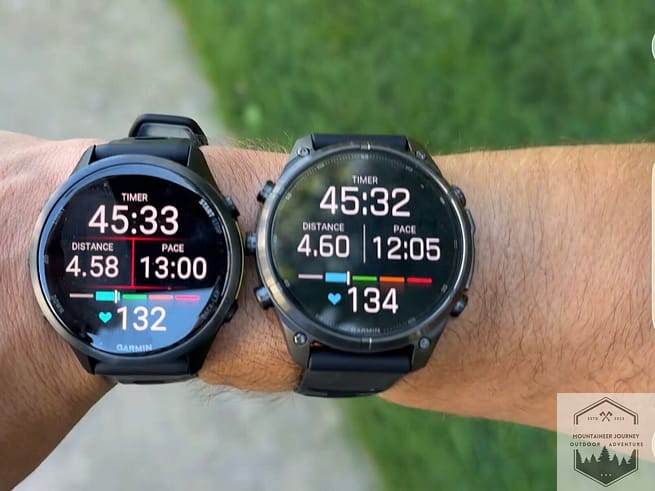
Heart rate accuracy tells a more nuanced story. The Mean Absolute Error of 6.0 bpm and RMSE of 9.2 bpm are noticeably higher than what we recorded with the Fenix 9’s identical Elevate Gen 5 sensor (0.9 bpm MAE on the Fenix 9).
The Maximum Delta of +30.9 bpm occurred during a pace surge where the optical sensor lagged behind the chest strap reading. During steady efforts, the Enduro 4’s heart rate accuracy stayed within 2 to 3 bpm of the Polar H10. During surges and recoveries, the lag was clear.
The 7.0-second interval latency means zone changes took 7 seconds to register on the wrist after the Polar H10 already showed the shift. For serious interval training where you need to hit a target zone within seconds, pairing an HR strap is still the better approach.
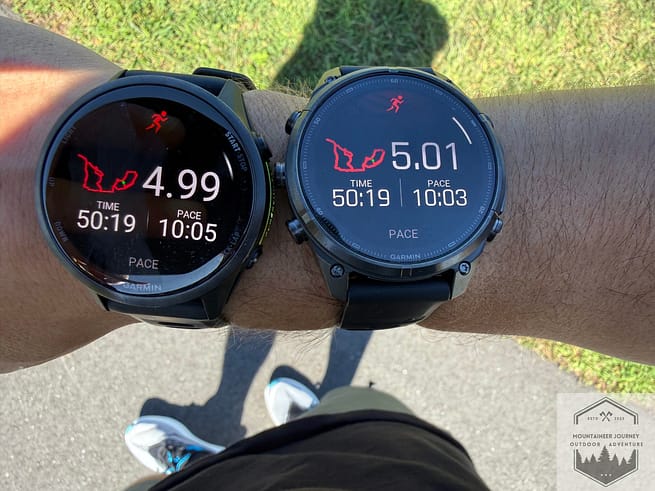
The Fréchet Drift of 56.8 feet tells you how far the recorded GPS track wandered from the preloaded GPX route across the entire 4 miles. This is pretty good for a solar-based watch GPS. Compare that to the Venu 4, which had 48 ft of drift for the same 4-mile run.
The −0.9% Distance Over Report means the Enduro 4 slightly undercounted total distance. On a 4-mile run, that translates to roughly 190 feet short. For training log purposes and race pacing, that margin is well within acceptable range.
GPS And Elevation Performance

On hikes, the Enduro 4 held a clean track in multi-band GNSS mode. Switchbacks on steep terrain showed the typical slight smoothing that wrist GPS devices produce; tight turns sometimes got rounded off by a few feet.
SatIQ technology helped here by automatically switching between multi-band and single-band GNSS depending on canopy density and signal quality, which preserves battery without forcing you to manually toggle modes.
Elevation tracking was consistent with what I have seen on the Enduro 3. ClimbPro recognized summits within about 20 vertical feet of actual GPS-tagged peaks.
Compared to both the Fenix 9 and Enduro 3, accuracy differences were small and mostly came down to how tightly the strap was worn and where the sensor sat on the wrist. The sensor stack is identical across all three watches, so this makes sense.
Accuracy Score: 7.5/10 (30%)
Battery Life: 20%

Garmin claims up to 36 days in smartwatch mode without solar, 90 days with solar charging, 120 hours of standard GPS, and up to 320 hours in extended battery mode with solar.
Battery life remains unchanged from Enduro 3 to Enduro 4, suggesting this generation’s gains went to RAM and software, not power efficiency. However, in the world of solar GPS watches, you can only gain so much in battery life.
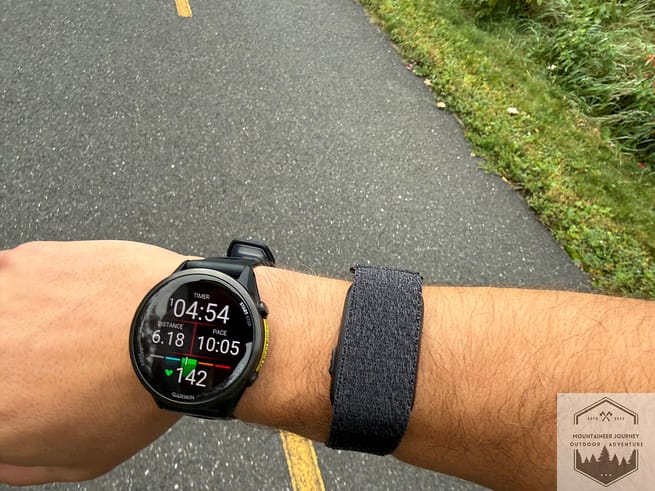
My real-world test pattern: 4 to 5 GPS activities per week (mix of trail runs and hikes averaging 2 to 4 hours each), always on MIP display, backlight set to high, maps used during every activity. Under those conditions, the Enduro 4 lasted 11 days before I charged it. That is with multi-band GNSS and max accuracy selected for every activity. I noticed around a 2% battery drain per 1-hour GPS workout.
Solar gain is real but context-dependent. For example, on a quick 1-hour hike with forest cover, I had zero battery gain while using GPS. It was closer to 2% drain. Solar charging requires long, extended hikes in mostly direct sunlight. Garmin’s marketing figures assume 3 hours per day in 50,000 lux sunlight, which is full direct sun.
Charging from roughly 10% to full on Garmin’s USB cable took about 2 hours. Not the fastest, but workable if you plug in at camp.
Battery Life Score: 9/10 (20%)
Mapping & Navigation: 20%

The Enduro 4 finally feels as responsive as the Fenix 9 for on-wrist maps, which is a meaningful jump from the Enduro 3. The reason is concrete: 50% more RAM and a mapping engine ported directly from the Fenix 9 line.
Garmin claims the mapping speed is 30% faster on the Enduro 4 compared to its predecessor, and it shows. Topo tiles load faster when panning; zooming does not cause the multi-second lag that plagued the Enduro 3.
The new perspective view is genuinely useful on approach hikes. Instead of the flat top down view, Perspective View angles the terrain so you can see both the immediate trail ahead and the broader ridgeline behind it.
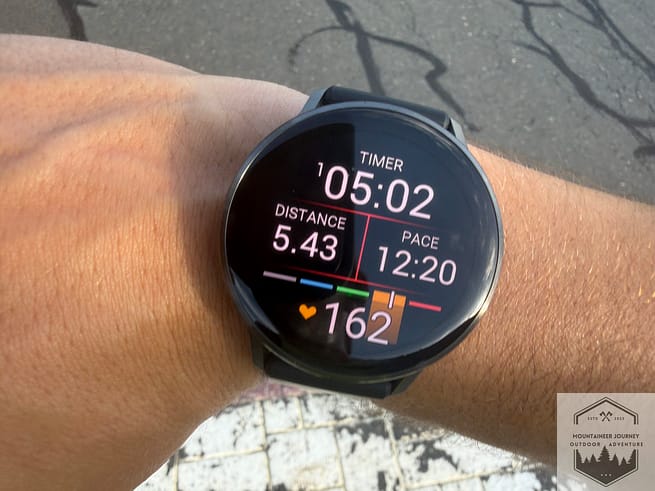
The MIP display really struggles on cloud-covered days. I really couldn’t see the map well at all, especially on days around 50,000 lux or less with cloud cover; I got a terrible reflection on the watch, even with the backlight on.
I was somewhat disappointed with the off-road alerts. While using trackback, I deliberately stepped off-trail, and it took 211 feet before I received an off-road alert. It also took a minute of standing still to trigger the alert. This isn’t a big deal on wide, open trails, but tight trails with many turns can cause issues with the delayed off-route alerts.
Following preloaded GPX files on 5-12 mile mountain loops, turn-by-turn navigation was accurate. Back-to-start navigation worked reliably. NextFork navigation handled closely spaced trail junctions without confusion.
Climb Pro looks significantly different on the Enduro 4 than on other watches like the 4970 or Fenix 9, which feature AMOLED displays. The climbing distance information is harder to read and lacks the color depth and clarity you might expect from those other models, especially if you’re transitioning from them.
Occasional lag showed up when I had multiple waypoints loaded alongside full topo maps and several glances trail running. However, switching between glances didn’t cause much lag.
Mapping & Navigation Score: 8.5/10 (20%)
Features & Training: 10%
Feature-wise, the Enduro 4 closely mirrors the Fenix 9’s software features. The Enduro 4 offers advanced training and endurance metrics, including most of the newest tools from the Fenix series, minus the communication hardware.
New stamina zones and endurance curves are the headline training additions. Stamina zones calculate how long you can sustain your current intensity based on your accumulated training data. The stamina curve shows your depletion rate in real time.

For example, during my interval runs, it showed how much longer I could hold an 8:15 running pace based on my previous training.
Grade-adjusted pace is another useful addition for trail runners and hikers; it normalizes your effort on uphills and downhills so you can compare a steep climb to a flat section on effort level rather than raw speed. This is great if you’re training for a trail race and then transitioning to a road race, where you want to calculate your pace on flatter terrain.
The rucking profile lets you set your pack weight before starting an activity. For backpackers, this means the watch factors load into calorie burn and effort calculations. On my hikes carrying 20 pounds, the rucking data gave a more realistic picture of exertion than the standard hiking profile, which assumes you are unburdened.
Enduro 4 features new Garmin Epic for multi-day events, which groups multiple days of activity into a single story. For thru-hikers, this is a cleaner way to review an entire trip instead of swiping through individual day files in Garmin Connect.
Body battery and sleep tracking carry over from previous Garmin watches. Training Readiness scores and HRV status are present and consistent with what I have seen on the Fenix 9 and Forerunner 970. Strength training profiles, indoor rowing metrics, and the full suite of multisport modes are all here.
What is missing matters, though. No on-wrist InReach means no satellite messaging or SOS. No microphone and no speaker mean no voice commands and no phone calls from the watch.
No dedicated diving capabilities beyond 10 ATM water resistance. These omissions are deliberate; they preserve battery. But for a $900 watch in 2026, the lack of InReach in particular stands out, given that the Fenix 9 Pro offers it for an additional $100 add-on.
Features & Training Score: 8.5/10 (10%)
Versatility: 10%

Day to day, the Enduro 4 wears like a tool watch that was not designed for the office. The case is 51 mm, and the stack height (or thickness) I measured is 16.9 mm, the biggest of any watch I have tested. Compared to the Garmin Vivoactive 6, which only has a stack height of 10 mm, you can understand how thick the Enduro 4 actually is.

The ComfortFit strap wicks moisture well and feels better than the older UltraFit nylon during my hikes. Sleeping with it on was uncomfortable, so I ended up taking it off most nights, which means you lose sleep-tracking data unless you tolerate the bulk. A good pairing device, if you want sleep data without wearing the Enduro 4 to bed, is the Garmin Cirqa.
One benefit is that I didn’t accidentally click buttons as I do on the newer Fenix 9, as they stick out so far. During wrist extensions while doing pushups, I wasn’t inadvertently pressing buttons.
Smartwatch features that work well: notifications mirror reliably from your phone, 64 GB of storage handles offline music playlists through Spotify, and the built-in LED flashlight (including red-light mode) is useful for waking in the middle of the night, etc.
The MIP display is a bummer for everyday use. Compare that to any other AMOLED watch or even your phone, and the contrast is stark.
Compared to wearing a Fenix 9 or Forerunner 970 during office days, casual walks, and gym sessions, the Enduro 4 feels like wearing a hockey puck without the invert and button pressing like on the Fenix 9.
Versatility Score: 7.5/10 (10%)
Is The Enduro 4 Worth It?

For backcountry hikers and ultra runners who need the ultimate battery life, the Enduro 4 is worth the $899.99. No other current Garmin watch matches its combination of GPS battery endurance, solar charging capability, and rugged build for extended wilderness use.
However, if you’ll be using the Enduro 4 for weekend hikes, trail runs, or easy road running, this isn’t the watch to go after. For easy road running miles with breadcrumb GPS, the Forerunner 170 is a great option. If you don’t need the extremely long battery life, the Forerunner 970 is $50 less and also is easier for everyday use and wear.
When comparing the Enduro 3 to the Enduro 4, if your Enduro 3 battery is still performing well and you aren’t interested in features like faster maps or new training metrics such as stamina zones, it makes sense to save $100 by sticking with your current watch.
Furthermore, if the Enduro 4 included an inReach option, the upgrade would have felt more valuable, particularly for users who would benefit from that feature. Overall, the upgrade is more of an incremental improvement than a groundbreaking change.
Against the Fenix 9: if you split your time between mountains and everyday life and want a brighter AMOLED screen, a smaller 47 mm case option, and the ability to add InReach for $100, the Fenix 9 is the better all-around watch. There’s also the Fenix 9 Pro Solar option with a MIP display.
Value Score: 7.5/10 (10%)
At $899.99, the Enduro 4 is a compelling package for its target user. But the lack of InReach at this price, combined with hardware that is nearly identical to the Enduro 3, makes the value proposition thinner than it should be.
If the Enduro 3 drops further in price, the savings become hard to ignore. For someone buying their first watch in this class, the Enduro 4 justifies its cost. For Enduro 3 owners, the upgrade is harder to recommend unless faster maps and doubled storage solve a problem you actually have.
Scoring Breakdown
Accuracy (30%): 7/10
Battery Life (20%): 9/10
Mapping & Navigation (20%): 8.5/10
Features & Training (10%): 8.5/10
Versatility (10%): 7.5/10
Value (10%): 7.5/10
Total Weighted Score:
2.10 + 1.80 + 1.70 + 0.85 + 0.75 + 0.75 = 7.95
Our Rating: 8.0/10
How We Tested And Our Methodology

Mountaineer Journey is a 100% independent publisher. We accept no sponsorships, and we buy every watch we test with our own money. I run the Mountaineer Journey YouTube Channel with over 8,000 subscribers and 3.8 million views, and I have logged more than 3,000 combined hiking, trail running, and road running miles over the past decade.
Our reviews aim to provide objective scores for all our watches based on thorough testing. We offer evidence in the form of pictures and videos showing us testing these watches in real-world conditions, rather than simply examining them at home and sharing opinions.
Every category score is based on objective testing, not brand claims.
Accuracy Testing
- Every test uses a Polar H10 chest strap as our heart rate baseline, worn simultaneously with the Enduro 4
- GPS routes, Polar H10 data, and Enduro 4 logs are fed into our Tracklab software to quantify GPS drift, distance error, and HR variance rather than eyeballing wiggly lines on a map
- We repeat tests in varied environments: wooded singletrack, open alpine ridges, canyon sections, and city streets
Battery Testing
- We log daily battery drain in smartwatch mode and during repeated GPS hikes and runs with consistent settings
- We test across Garmin’s Activity Mode choices (max accuracy, normal, max battery mode) while keeping screen brightness and mapping usage constant to isolate the variable
Mapping & Navigation Testing
- We preload verified GPX files for common local test loops and multi day routes, then compare the Enduro 4 track to those references after each outing
- We score not only route following but also how quickly map tiles draw, how fast panning responds, and whether off-course alerts fire when we deliberately leave the trail
Features, Versatility, And Value
- We live with the watch for daily use: sleep, work, errands, gym, and long trail days, to see which features actually matter once the novelty wears off
- Value is not about the cheapest price tag but whether the watch’s strengths justify its cost compared with Garmin alternatives and what our readers actually need for hiking and trail running


Tyler
Tyler is the founder Mountaineer Journey and a professional Mountain Guide with 16+ years of technical experience in trekking, mountaineering, and running. Having logged thousands of miles from rugged alpine summits to training for half marathons, Tyler provides rigorous, field-tested insights on hiking, walking, and trail running gear. All reviews are 100% unsponsored and unbiased, ensuring you get honest scoring based on real-world performance. His mission is to help outdoor enthusiasts of all levels find reliable equipment that ensures comfort, safety, and performance on any terrain.