Our Score
New Balance Hierro Hiker GTX Review | Unsponsored

In this article, I’m going to share my HONEST New Balance Hierro Hiker GTX review for those wondering whether they are WORTH IT in 2026.
With my 16+ years of hiking experience, I put this boot through its paces on basalt slabs, packed dirt singletrack, loose gravel, and wet leaf-covered hillsides to give you a complete breakdown.
The New Balance Fresh Foam X Hierro Hiker GTX sits at an interesting crossroads in New Balance’s lineup. It takes the beloved Fresh Foam X Hierro trail running platform and wraps it in a mid-cut boot upper with a Gore-Tex membrane, Vibram Megagrip outsole, and reinforced toe and heel protection. The result is a hiking boot that feels more like a trail runner than anything else in its class.
For this review, I logged 30+ hikes on my own pair. I know how these boots feel fresh out of the box and how they hold up after weeks of hard use.
If you are a cushy day hiker or light overnighter who wants running shoe comfort with some ankle coverage, the Hierro Hiker GTX is a strong contender. But stability under load is its weak link.
I will cover comfort, traction, overall protection, waterproofness, fit, stability and support, durability, and value, plus direct comparisons to the Hoka Anacapa 2, Kaha 3, and Adidas Terrex Free Hiker 3.
Hierro Hiker GTX Pros and Cons
Pros
- Great overall comfort
- Vibram Megagrip outsole with microspikes
- Lightweight
Cons
- Stability issues with overpronation
- Cramped Toe Box
- Low Breathability
Hierro Hiker GTX Price
As of this writing, the Hierro Hiker retails for $195.
Should You Buy The New Balance Hierro Hiker GTX?
Buy If
- You mostly hike moderate dirt and gravel singletrack rather than steep off-trail scree
- You love a soft, cushioned feel for easy hikes
- You hike in cooler, wetter shoulder seasons where Gore Tex makes sense
- You prefer a lighter, more flexible boot over a stiff full leather option
Do Not Buy If
- You regularly carry a heavy pack on multi-day trips and need rock-solid midfoot and heel stability
- You spend much time on steep, off-camber basalt, or boulder fields where overpronation becomes risky
- Your feet already overpronate, and you rely on a TPU shank or firm chassis for support
- You want a very roomy toe box for wider feet
Comfort: 9/10

My first impression of slipping on the New Balance Hierro Hiker GTX was how much it felt like lacing up trail shoes rather than a traditional hiking boot. The heel comfort and sock liner stood out immediately. That sock liner has generous padding that cradles the heel without any pressure over the Achilles, and it felt supportive yet forgiving right out of the box.
The Fresh Foam X midsole is the star here. The midsole foam uses a dual-density design with a firmer layer beneath for stability and a softer layer on top for cushioning. The midsole is extremely soft and provides a nice plush landing. However, this can be cumbersome, especially on technical trails, due to overcompression.
The impact absorption is excellent; however, it still falls short of the Hoka Anacapa 2 in terms of comfort while hiking, as the shock absorption is not as effective with a 20 lb. backpack during my testing.
The ankle collar padding is well executed. The tongue sits flush against the top of your foot without digging in, even when cinched snug. On longer hikes with thicker socks, I noticed the upper initially feels a bit snug over the instep, but no real pressure points developed.
Worth noting that on varying sock weights, the boot adjusts well because of the flexible mesh and synthetic construction.
There is virtually no break-in period, and the foam cushioning stayed consistent after 30 to 50 miles on basalt and singletrack. It did not compress noticeably in that range, which is a good sign for a balanced fresh foam midsole.
Weight

I weighed my men’s 10.5 at 15.5 oz per pair on our calibrated scale. It weighs similarly to the Salomon X Ultra 5 (under 16 oz), but it can also feel slightly heavy underfoot because of the massive stack outsole.
Traction: 8.5/10

Traction is one of the standout features of the New Balance Fresh Foam X Hierro Hiker. It features a Vibram Megagrip outsole designed with traction lugs, including chevron-shaped lugs and rubber microspikes, similar to those found on the Hoka Kaha 3.
Those roughened surfaces around the lugs help bite into loose material and hold an edge on side slopes.
On dirt-packed singletrack, the boot was outstanding. Climbs got traction early, and controlled descents on loose dirt and gravel gave me real confidence.
On wet, leaf-covered hills where the outsole needed to bite through slick organic matter, the micro-texturing on the lugs helped shed water and maintain edge. Traction was great in both dry conditions and when those trails were soaked after a morning rain.
Over loose basalt and granite, the outsole adapted well. However, I did notice that the lugs did not hold as well on muddy trails. Some other limitations I noted was very steep, mossy rock faces and slick wet rock slabs.
The boot’s flexible platform worked against me a bit because the soft midsole foam could compress under heavy weight, causing the foothold to flatten. On boulder fields, I sometimes felt less planted even though the rubber gripped well. The high stack dampens trail-feel, which is great for comfort but reduces ground feel and precision in foot placement on technical trails.
Overall Protection: 3/5

Starting at the front of the boot, the Toe Protect overlay uses a durable leather toe bumper combined with suede and synthetic materials. The toe bumper is pretty resistant against root kicks, but not the most protective as more rugged models such as the Salomon Quest 5 or Timberland Mt Maddsen 2.0.
The synthetic material in the midfoot is exposed and quite thin, so abrasive trail terrain may rip through this layer. I was a little concerned when I was moving through covered bushes where I couldn’t exactly see where my feet were going.
The collar padding mutes side knocks at the ankle, and hiking footwear with a mid cut design provides additional ankle coverage compared to low cut shoes. However, the flexibility of the upper, built from mesh and synthetics rather than leather, means less rigid lateral protection compared to something like the Kaha 3. On basalt ledges and in thick brush, I felt protected but not bombproof.
Water Resistance: 4.5/5

The Hierro Mid GTX features a Gore-Tex waterproof lining using the Invisible Fit construction, which bonds the Gore-Tex membrane directly to the upper for a cleaner interior feel.
The only other boot we have tested with Gore-Tex Invisible Fit is the Hoka Kaha 3, and Invisible Fit does make a slight difference in breathability. That being said, the Hierro Hiker remained completely dry during our 10-minute submersion test and multiple creek crossings.
The semi-gusseted tongue does limit how far you can go in the water. Therefore, I only recommend staying in slightly below ankle-deep water. Otherwise, you’ll get fully submerged.
How Does The New Balance Hierro Hiker Fit?
Size-wise, I recommend moving up a half size. The toe box is quite cramped for me. The length feels a bit short, and when descending gravel and basalt, the toe box does not leave enough room for toes to splay.
The boot’s internal volume is adaptable because it is not full-grain leather. The flexible mesh and synthetic upper give over time, so the overall fit loosens slightly after a handful of outings.
The lacing hardware works well. I got a snug fit without pressure points over the top of my foot, and the laces held their tension throughout long hikes. The tongue sits comfortably against the instep without bunching.
If you have wide feet, I would stay away from these hiking boots. A comparable option with the same comfort, but a better, more adaptable, wider fit, is the Hoka Anacapa 2.
Fit: 3.5/5
Stability & Support: 3/5

I need to be upfront: stability is the New Balance Hierro Hiker’s main weakness, and it is the one area that keeps this boot from earning a higher overall score.
Ankle support is actually decent. The collar height wraps nicely and feels safer than low-cut models on moderate sidehill dirt and gravel. I had no issues with the ankle rolling on straightforward singletrack, and the collar padding gives confidence on moderate terrain.
Foot and midfoot stability is a different story entirely because of the overpronation. I noted that in my left foot specifically, there is noticeable inward rolling when traversing slanted basalt and uneven gravel. Unfortunately, this boot does not have enough arch support to resist that overpronation and/or has any TPU shank or stabilizer in the midfoot.
The softer Fresh Foam, especially in the heel, can cause overcompression issues as well. When I tested these on uneven boulder fields, I couldn’t keep my foot fully planted because my heel felt wobbly.
Even with a lighter daypack like the Osprey Talon 22, I noticed the overcompression was even more significant with just 10-15 pounds of added weight. Keep the Hierro Hiker for mild to moderate trails. You should exercise real caution on technical trails because of the significant stability issues
Stability And Support: 3/5
Durability
The upper held up well in my testing. The synthetic mesh panels and overlays showed some surface abrasion from the trail, but no fraying or delamination.
The heel collar and padding area is where I have a slight concern. I noticed some thinning of the collar fabric at the back where the Achilles moves against the heel tab. This is something I would continue to monitor, but it can cause separation between these two panels over time.
So far, the Fresh Foam X midsole has retained its energy return. It doesn’t feel like I’ve lost any sort of bounce each time I take them out on the trail. The Vibram Megagrip outsole has not shown any significant wear, and the microspikes still have good integrity, which typically is the first part of the outsole that begins to break down.
Durability: 8/10
Is The New Balance Hierro Hiker GTX Worth It?

Yes, the New Balance Hierro Hiker GTX is worth it for the right hiker. If you want a lightweight, cushioned, waterproof boot, this one delivers. The comfort is excellent, with the heel and sock liner standing out as some of the best I have worn. It is just a small step behind the Hoka Anacapa 2 for shock and impact absorption, but for most day hikes, you will not notice the difference.
The main drawback is stability and overpronation under load. The lack of a TPU shank or stabilizer in the midfoot and heel is a bigger disadvantage in this boot than some may realize
If you carry heavy loads on technical trails or have existing pronation issues, the Hoka Kaha 3 GTX is the better option. For those who want more comfort and a roomier toe box without the ankle coverage, the Hoka Anacapa 2 is worth a look. You can find both on our best hiking boots of 2026 list.
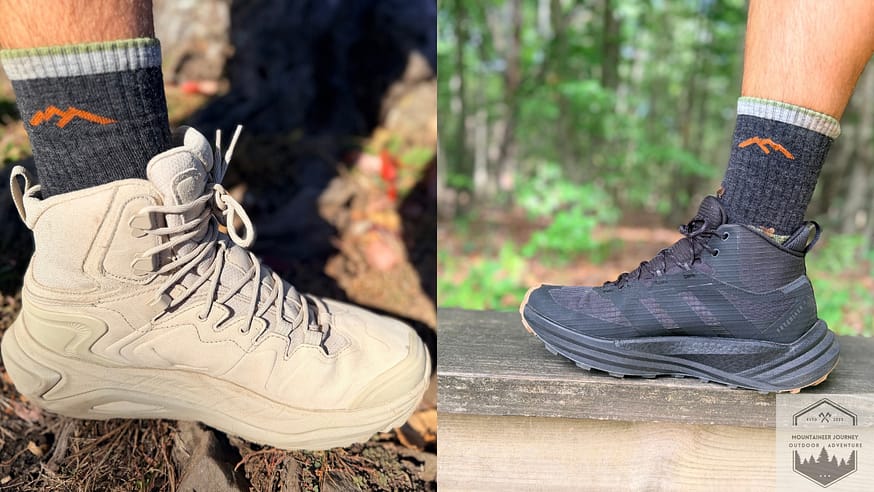
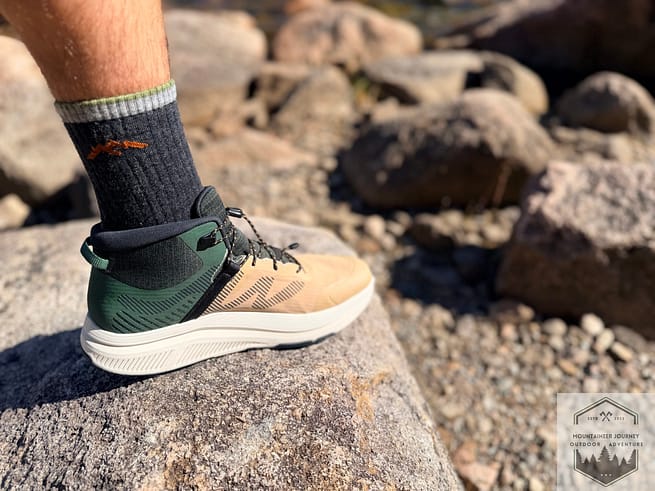
For a hiking boot with the same cushioning but even lighter, check out the Adidas Terrex Free Hiker 3. The Arc’teryx Konseal Trek boot is a good option for a more rugged, stable model for those who want more support.
Value: 4/5
Scoring Breakdown
Comfort: 9/10
Traction: 8.5/10
Overall Protection: 3/5
Waterproofness: 4.5/5
Fit: 3/5
Stability & Support: 3/5
Value: 4/5
Total: 35 / 45
Our Rating: 7.7 / 10
How We Tested and Our Methodology

I personally tested the New Balance Hierro Hiker GTX to give you the most unbiased review possible. Mountaineer Journey is a 100% independent publisher with years of testing and reviewing outdoor equipment. We purchase all of our test pairs at retail. No company or manufacturer pays us to sway our opinions.
We test all our hiking boots with objective testing, scoring categories, 16+ years of experience, and 3,500+ miles logged across diverse terrain and National Parks.


Tyler
Tyler is the founder Mountaineer Journey and a professional Mountain Guide with 16+ years of technical experience in trekking, mountaineering, and running. Having logged thousands of miles from rugged alpine summits to training for half marathons, Tyler provides rigorous, field-tested insights on hiking, walking, and trail running gear. All reviews are 100% unsponsored and unbiased, ensuring you get honest scoring based on real-world performance. His mission is to help outdoor enthusiasts of all levels find reliable equipment that ensures comfort, safety, and performance on any terrain.